


Page 168 - Innovator's Science-8
P. 168
From  Table  you  can  iden fy  the  heterotrophs  these  include  all  animals  and
                                      mushrooms  (fungi),  since  they  do  not  photosynthesise  and  depend  on  other
                                      organisms for food.


                                     Consumers and their Types
                                     We have read that all animals depend on plants for their food. They are,
                                     thus, consumers. Not all consumers are of same types.

                                     •  Herbivores:   Animals that eat only plants (e.g., deer, horse).

                                     •  Carnivores:   Animals that eat only other animals (e.g., vulture, bird).
                                     •  Omnivores:    Animals that eat both plants and animals (e.g., fox, mouse,

                                        squirrel).
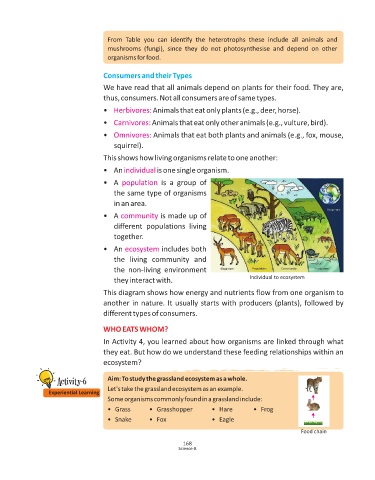
                                     This shows how living organisms relate to one another:

                                     •  An individual  is one single organism.

                                     •  A  population    is  a  group  of
                                        the same type of organisms
                                        in an area.

                                     •  A community      is made up of
                                        different  populations  living
                                        together.

                                     •  An ecosystem     includes both
                                        the  living  community  and
                                        the  non-living  environment

                                        they interact with.                            Individual to ecosystem
                                     This diagram shows how energy and nutrients flow from one organism to
                                     another in nature. It usually starts with producers (plants), followed by

                                     different types of consumers.

                                     WHO EATS WHOM?

                                     In Activity 4, you learned about how organisms are linked through what
                                     they eat. But how do we understand these feeding relationships within an
                                     ecosystem?


                     Activity-6       Aim: To study the grassland ecosystem as a whole.
                                      Let's take the grassland ecosystem as an example.
                  Experiential Learning
                                      Some organisms commonly found in a grassland include:

                                      •   Grass      •   Grasshopper      •   Hare       •   Frog
                                      •   Snake      •   Fox              •   Eagle
                                                                                                         Food chain

                                                                168
                                                               Science-8

