


Page 171 - Innovator's Science-8
P. 171
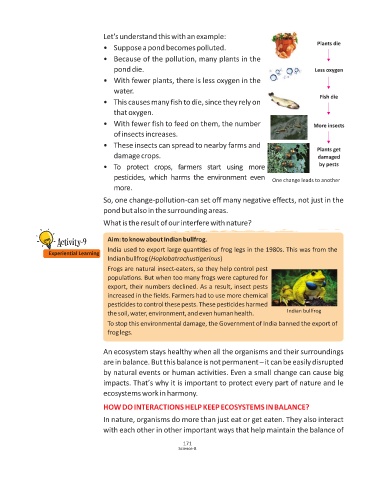
Let's understand this with an example:
                                                                                                               Plants die
                                     •  Suppose a pond becomes polluted.
                                     •  Because of the pollution, many plants in the
                                        pond die.                                                             Less oxygen

                                     •  With fewer plants, there is less oxygen in the
                                        water.
                                                                                                                Fish die
                                     •  This causes many fish to die, since they rely on

                                        that oxygen.
                                     •  With fewer fish to feed on them, the number                          More insects
                                        of insects increases.
                                     •  These insects can spread to nearby farms and
                                                                                                               Plants get
                                        damage crops.                                                          damaged
                                     •  To  protect  crops,  farmers  start  using  more                       by pests

                                        pesticides,  which  harms  the  environment  even      One change leads to another
                                        more.
                                     So, one change-pollution-can set off many negative effects, not just in the

                                     pond but also in the surrounding areas.
                                     What is the result of our interfere with nature?


                     Activity-9       Aim: to know about Indian bullfrog.
                                      India used to export large quan  es of frog legs in the 1980s. This was from the
                  Experiential Learning
                                      Indian bullfrog (Hoplobatrachus gerinus)
                                      Frogs are natural insect-eaters, so they help control pest
                                      popula ons. But when too many frogs were captured for
                                      export, their numbers declined. As a result, insect pests
                                      increased in the fields. Farmers had to use more chemical
                                      pes cides to control these pests. These pes cides harmed
                                      the soil, water, environment, and even human health.          Indian bullfrog
                                      To stop this environmental damage, the Government of India banned the export of
                                      frog legs.


                                     An ecosystem stays healthy when all the organisms and their surroundings
                                     are in balance. But this balance is not permanent – it can be easily disrupted

                                     by natural events or human activities. Even a small change can cause big
                                     impacts. That’s why it is important to protect every part of nature and le
                                     ecosystems work in harmony.

                                     HOW DO INTERACTIONS HELP KEEP ECOSYSTEMS IN BALANCE?

                                     In nature, organisms do more than just eat or get eaten. They also interact
                                     with each other in other important ways that help maintain the balance of

                                                                171
                                                               Science-8

