


Page 173 - Innovator's Science-8
P. 173
Examples:

                                        Orchids use the tree for support and better access to sunlight, but the
                                            tree is not harmed.
                                        •  Orchids growing on trees:

                                        •  Remora fish and sharks:

                                            The remora attaches itself to a shark and eats leftover food particles.
                                            The shark doesn’t gain or lose anything.
                                        •  Birds nesting in trees:

                                            Birds use tree branches to build nests. The tree is not harmed by this.

                                     3.  Parasitism
                                        In parasitism, one organism benefits, but the other is harmed.

                                        This is a win-lose relationship. The parasite depends on the host for food
                                        or shelter, often weakening it or making it sick.

                                        Examples:
                                        •  Ticks or lice on dogs:

                                            The parasite feeds on the dog’s blood and
                                            may cause irritation or diseases.
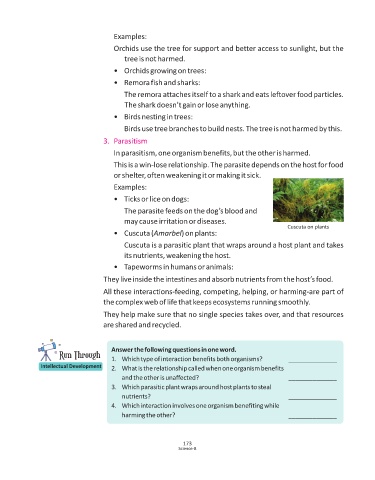
                                                                                                    Cuscuta on plants
                                        •  Cuscuta (Amarbel) on plants:
                                            Cuscuta is a parasitic plant that wraps around a host plant and takes
                                            its nutrients, weakening the host.

                                        •  Tapeworms in humans or animals:

                                     They live inside the intestines and absorb nutrients from the host’s food.
                                     All these interactions-feeding, competing, helping, or harming-are part of
                                     the complex web of life that keeps ecosystems running smoothly.

                                     They help make sure that no single species takes over, and that resources
                                     are shared and recycled.


                                        Answer the following questions in one word.
                      Run Through
                                        1.  Which type of interaction benefits both organisms?        ______________
               Intellectual Development  2.  What is the relationship called when one organism benefits

                                           and the other is unaffected?                              ______________
                                        3.  Which parasitic plant wraps around host plants to steal
                                           nutrients?                                                ______________
                                        4.  Which interaction involves one organism benefiting while
                                           harming the other?                                        ______________


                                                                173
                                                               Science-8

