


Page 170 - Innovator's Science-8
P. 170
WHAT HAPPENS TO WASTE IN NATURE?

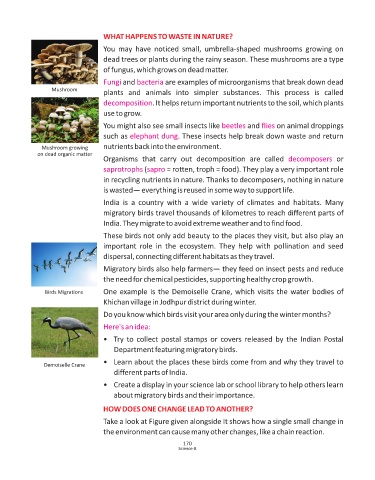
                                     You  may  have  noticed  small,  umbrella-shaped  mushrooms  growing  on
                                     dead trees or plants during the rainy season. These mushrooms are a type
                                     of fungus, which grows on dead matter.

                                     Fungi and  bacteria are examples of microorganisms that break down dead
                   Mushroom
                                     plants  and  animals  into  simpler  substances.  This  process  is  called
                                     decomposition. It helps return important nutrients to the soil, which plants

                                     use to grow.
                                     You might also see small insects like beetles     and flies  on animal droppings

                                     such as elephant dung     . These insects help break down waste and return
               Mushroom growing      nutrients back into the environment.
              on dead organic matter
                                     Organisms  that  carry  out  decomposition  are  called  decomposers            or
                                     saprotrophs sapro = rotten, troph = food). They play a very important role
                                                   (

                                     in recycling nutrients in nature. Thanks to decomposers, nothing in nature
                                     is wasted— everything is reused in some way to support life.

                                     India  is  a  country  with  a  wide  variety  of  climates  and  habitats.  Many
                                     migratory birds travel thousands of kilometres to reach different parts of
                                     India. They migrate to avoid extreme weather and to find food.

                                     These birds not only add beauty to the places they visit, but also play an
                                     important  role  in  the  ecosystem.  They  help  with  pollination  and  seed
                                     dispersal, connecting different habitats as they travel.

                                     Migratory birds also help farmers— they feed on insect pests and reduce

                                     the need for chemical pesticides, supporting healthy crop growth.
                 Birds Migrations    One example is the Demoiselle Crane, which visits the water bodies of
                                     Khichan village in Jodhpur district during winter.

                                     Do you know which birds visit your area only during the winter months?

                                     Here's an idea:
                                     •  Try to collect postal stamps or covers released by the Indian Postal

                                        Department featuring migratory birds.
                                     •  Learn about the places these birds come from and why they travel to
                Demoiselle Crane
                                        different parts of India.
                                     •  Create a display in your science lab or school library to help others learn
                                        about migratory birds and their importance.

                                     HOW DOES ONE CHANGE LEAD TO ANOTHER?

                                     Take a look at Figure given alongside It shows how a single small change in
                                     the environment can cause many other changes, like a chain reaction.

                                                                170
                                                               Science-8

