


Page 165 - Innovator's Science-8
P. 165
Why do you think is the reason for this?

                                     Let's compare the number of dragonflies, bees, and butterflies in each
                                     pond.

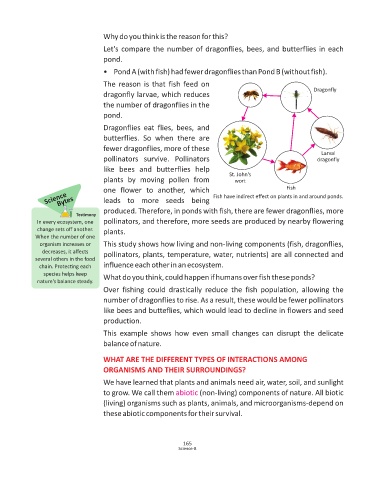
                                     •  Pond A (with fish) had fewer dragonflies than Pond B (without fish).
                                     The  reason  is  that  fish  feed on
                                                                                                             Dragonfly
                                     dragonfly larvae, which reduces
                                     the number of dragonflies in the
                                     pond.

                                     Dragonflies  eat  flies,  bees,  and
                                     butterflies.  So  when  there  are
                                     fewer dragonflies, more of these
                                                                                                                Larval
                                     pollinators  survive.  Pollinators                                        dragonfly
                                     like  bees  and  butterflies  help
                                                                                St. John's
                                     plants  by  moving  pollen  from             wort
                                     one  flower  to  another,  which                               Fish
                 Science             leads  to  more  seeds  being         Fish have indirect effect on plants in and around ponds.
                     Bytes

                                     produced. Therefore, in ponds with fish, there are fewer dragonflies, more
                           Testimony
              In every ecosystem, one   pollinators, and therefore, more seeds are produced by nearby flowering
              change sets off another.   plants.
             When the number of one
               organism increases or   This study shows how living and non-living components (fish, dragonflies,
                decreases, it affects   pollinators, plants, temperature, water, nutrients) are all connected and
             several others in the food
               chain. Protec ng each   influence each other in an ecosystem.
                species helps keep   What do you think, could happen if humans over fish these ponds?
              nature's balance steady.
                                     Over  fishing  could  drastically  reduce  the  fish  population,  allowing  the
                                     number of dragonflies to rise. As a result, these would be fewer pollinators
                                     like bees and butteflies, which would lead to decline in flowers and seed
                                     production.

                                     This  example  shows  how  even  small  changes  can  disrupt  the  delicate
                                     balance of nature.


                                     WHAT ARE THE DIFFERENT TYPES OF INTERACTIONS AMONG
                                     ORGANISMS AND THEIR SURROUNDINGS?

                                     We have learned that plants and animals need air, water, soil, and sunlight
                                     to grow. We call them abiotic    (non-living) components of nature. All biotic
                                     (living) organisms such as plants, animals, and microorganisms-depend on
                                     these abiotic components for their survival.


                                                                165
                                                               Science-8

