


Page 174 - Innovator's Science-8
P. 174
WHAT ARE THE BENEFITS OF AN ECOSYSTEM?

                                     In an ecosystem, living (biotic) and non-living (abiotic) components work
                                     together  and  support  life.  Humans  also  benefit  in  many  ways  from
                                     ecosystems.

                                     For example:
                                        Forests give us:

                                        •   Clean air (oxygen)              •   Fertile soil
                                        •   Food and fibres                 •   Wood and timber

                                        •   Medicines
                                        Aquatic ecosystems (like rivers, lakes, and oceans) provide:

                                        •   Water

                                        •   Fish and other food sources

                                        Ecosystems also give us:
                                        •   Natural beauty (aesthetic value)
                                        •   Places to relax or enjoy nature (recreational value)

                                     These benefits show how closely connected humans and nature are. But
                                     when we overuse or misuse these resources, it disturbs the natural balance

                                     and harms the environment.
                                     Now let us look at a real life example of a threatened ecosystem – the
                                     Sunderbans.

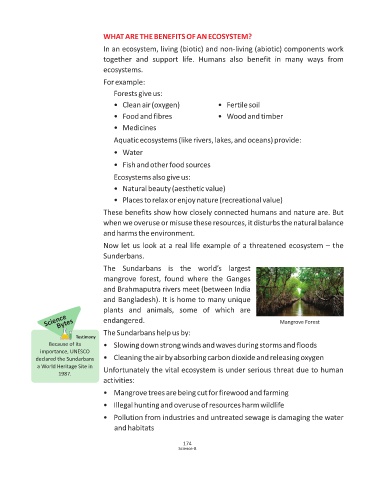
                                     The  Sundarbans  is  the  world’s  largest
                                     mangrove  forest,  found  where  the  Ganges

                                     and Brahmaputra rivers meet (between India
                                     and Bangladesh). It is home to many unique
                                     plants  and  animals,  some  of  which  are
                 Science             endangered.                                                  Mangrove Forest
                     Bytes
                                     The Sundarbans help us by:
                           Testimony
                  Because of its     •  Slowing down strong winds and waves during storms and floods
               importance, UNESCO
             declared the Sundarbans   •  Cleaning the air by absorbing carbon dioxide and releasing oxygen
              a World Heritage Site in   Unfortunately the vital ecosystem is under serious threat due to human
                     1987.
                                     activities:

                                     •  Mangrove trees are being cut for firewood and farming

                                     •  Illegal hunting and overuse of resources harm wildlife
                                     •  Pollution from industries and untreated sewage is damaging the water

                                        and habitats

                                                                174
                                                               Science-8

