


Page 179 - Innovator's Science-8
P. 179
•  Examples of ecosystems include: Terrestrial ecosystems like forests, deserts, and grasslands and Aquatic
                 ecosystems like ponds, lakes, rivers, and oceans.
             •  Organisms in an ecosystem can be grouped based on how they get their food: Producers - Plants that make
                 their own food using sunlight, Consumers Animals that eat plants or other animals and i Decomposers-
                 Microorganisms like fungi and bacteria that break down dead plants and animals, recycling nutrients back
                 into the soil.
             •  A food chain shows the sequence of "who eats whom" in an ecosystem.
             •  A  food  web  is  a  network  of  interconnected  food  chains,  showing  how  energy  flows  through  many
                 organisms.
             •  The position of organisms in a food chain is called a trophic level.
             •  Organisms  also  live  in  special  types  of  relationships:  Mutualism  in  which  both  organisms  benefit,
                 Commensalism in which one benefits, the other is unaffected and Parasitism- One benefits, the other is
                 harmed.
             •  We must take action to conserve ecosystems. Creating and maintaining protected areas like: National
                 parks, Wildlife sanctuaries and Biosphere reserves.


                                                   NCERT Textbook Questions (Solved)


            Let Us Enhance Our Learning
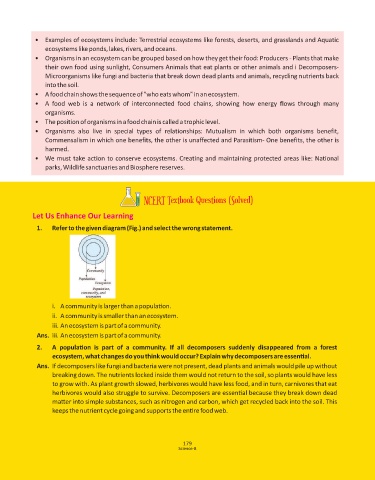
              1.   Refer to the given diagram (Fig.) and select the wrong statement.


                   i.  A community is larger than a popula on.

                   ii.  A community is smaller than an ecosystem.
                   iii. An ecosystem is part of a community.
              Ans.  iii. An ecosystem is part of a community.
              2.   A  popula on  is  part  of  a  community.  If  all  decomposers  suddenly  disappeared  from  a  forest
                   ecosystem, what changes do you think would occur? Explain why decomposers are essen al.
              Ans.  If decomposers like fungi and bacteria were not present, dead plants and animals would pile up without
                   breaking down. The nutrients locked inside them would not return to the soil, so plants would have less
                   to grow with. As plant growth slowed, herbivores would have less food, and in turn, carnivores that eat
                   herbivores would also struggle to survive. Decomposers are essen al because they break down dead
                   ma er into simple substances, such as nitrogen and carbon, which get recycled back into the soil. This
                   keeps the nutrient cycle going and supports the en re food web.


                                                                179
                                                               Science-8

