


Page 181 - Innovator's Science-8
P. 181
8.   Human-made ecosystems like agricultural fields are necessary, but they must be made sustainable.'
                   Comment on the statement.
              Ans.  Agree. Agricultural fields provide food but o en use unsustainable prac ces (e.g., synthe c fer lisers,
                   monoculture) that degrade soil and harm biodiversity. Sustainable methods (e.g., organic farming, crop
                   rota on) ensure long-term produc vity and environmental health.
                   If the Indian hare popula on (Fig.) drops because of a disease, how would it affect the number of other
                   organisms?

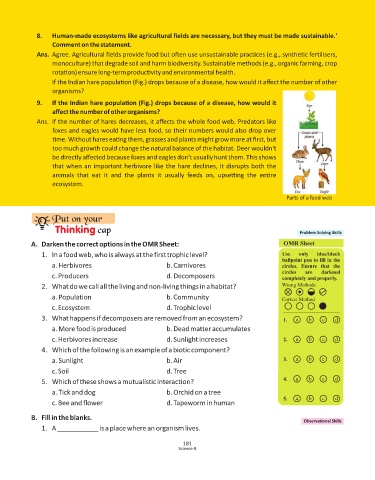
              9.   If the Indian hare popula on (Fig.) drops because of a disease, how would it
                   affect the number of other organisms?
              Ans.  If the number of hares decreases, it affects the whole food web. Predators like
                   foxes and eagles would have less food, so their numbers would also drop over
                    me. Without hares ea ng them, grasses and plants might grow more at first, but
                   too much growth could change the natural balance of the habitat. Deer wouldn't
                   be directly affected because foxes and eagles don't usually hunt them. This shows
                   that when an important herbivore like the hare declines, it disrupts both the
                   animals  that  eat  it  and  the  plants  it  usually  feeds  on,  upse ng  the  en re
                   ecosystem.

                                                                                                    Parts of a food web


                   Put on your

                    Thinking cap                                                                         Problem Solving Skills

            A.  Darken the correct options in the OMR Sheet:                                       OMR Sheet
               1.  In a food web, who is always at the first trophic level?
                   a. Herbivores                           b. Carnivores

                   c. Producers                            d. Decomposers
               2.  What do we call all the living and non-living things in a habitat?             Wrong Methods
                   a. Population                           b. Community                           Correct Method

                   c. Ecosystem                            d. Trophic level
               3.  What happens if decomposers are removed from an ecosystem?                      1.  a    b   c    d
                   a. More food is produced                b. Dead matter accumulates
                   c. Herbivores increase                  d. Sunlight increases                   2.  a    b   c    d

               4.  Which of the following is an example of a biotic component?
                   a. Sunlight                             b. Air                                  3.  a    b   c    d
                   c. Soil                                 d. Tree

               5.  Which of these shows a mutualistic interaction?                                 4.  a    b   c    d
                   a. Tick and dog                         b. Orchid on a tree
                                                                                                   5.  a    b   c    d
                   c. Bee and flower                       d. Tapeworm in human
            B.  Fill in the blanks.
                                                                                                          Observational Skills
               1.  A ___________ is a place where an organism lives.

                                                                181
                                                               Science-8

