


Page 185 - Innovator's Science-8
P. 185
Discuss  these  listed  features  with  your  classmates.  You’ll  discover  that
                                     Earth supports life in man ways-by giving us air to breathe, water to drink,

                                     and soil for growing food. It also provides essential material like rocks and
                                     wood, which we use to construct homes, buildings, and roads.
                                     So, what exactly makes Earth a unique planet? It not only supports life like

                                     ours but also creates the perfect conditions for it to survive and thrive.

                                     WHAT DO THE PLANETS OF OUR SOLAR SYSTEM LOOK LIKE?

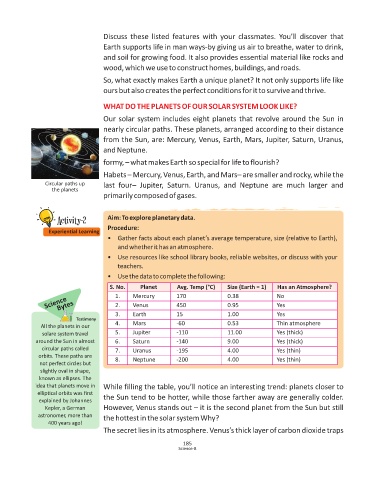
                                     Our solar system includes eight planets that revolve around the Sun in
                                     nearly circular paths. These planets, arranged according to their distance
                                     from the Sun, are: Mercury, Venus, Earth, Mars, Jupiter, Saturn, Uranus,

                                     and Neptune.
                                     formy, – what makes Earth so special for life to flourish?

                                     Habets – Mercury, Venus, Earth, and Mars– are smaller and rocky, while the
                 Circular paths up   last  four–  Jupiter,  Saturn.  Uranus,  and  Neptune  are  much  larger  and
                   the planets
                                     primarily composed of gases.


                     Activity-2       Aim: To explore planetary data.
                                      Procedure:
                  Experiential Learning
                                      •  Gather facts about each planet’s average temperature, size (rela ve to Earth),
                                          and whether it has an atmosphere.
                                      •  Use resources like school library books, reliable websites, or discuss with your
                                          teachers.
                                      •  Use the data to complete the following:
                                       S. No.     Planet      Avg. Temp (°C)    Size (Earth = 1)  Has an Atmosphere?

                 Science                 1.    Mercury        170               0.38             No
                     Bytes
                                         2.
                                                                                                 Yes
                                                                                0.95
                                                              450
                                               Venus
                                         3.    Earth          15                1.00             Yes
                           Testimony
               All the planets in our    4.    Mars           -60               0.53             Thin atmosphere
                solare system travel     5.    Jupiter        -110              11.00            Yes (thick)
             around the Sun in almost    6.    Saturn         -140              9.00             Yes (thick)
                circular paths called    7.    Uranus         -195              4.00             Yes (thin)
              orbits. These paths are    8.    Neptune        -200              4.00             Yes (thin)
               not perfect circles but
               slightly oval in shape,
               known as ellipses. The
             idea that planets move in   While filling the table, you’ll notice an interesting trend: planets closer to
              ellip cal orbits was first   the Sun tend to be hotter, while those farther away are generally colder.
              explained by Johannes
                 Kepler, a German    However, Venus stands out – it is the second planet from the Sun but still
              astronomer, more than   the hottest in the solar system Why?
                  400 years ago!
                                     The secret lies in its atmosphere. Venus’s thick layer of carbon dioxide traps

                                                                185
                                                               Science-8

