


Page 189 - Innovator's Science-8
P. 189
THE LIVING PLANET – HOW EARTH SUSTAINS LIFE

                                     Earth offers the right conditions for life, but what truly enables life to thrive
                                     is the intricate connection between living and non-living things. previous
                                     classes,  you  explored  important  natural  resources  such  as  air,  water
                                     sunlight, soil, and minerals. You also learned how plants and animals carry

                                     out vital life processes.
                                     In this section, we’ll delve into how all these elements work together in

                                     harmony, creating a balanced system that nurtures and sustains life on our
                                     remarkable planet.

                                     Air, Water, and Sunlight                                        Water

                                     The Earth’s atmosphere contains oxygen,
                 Science             which  is  essential  for  the  survival  of                              O 2
                     Bytes
                                     humans,  animals,  and  plants.  In  the          Light energy            Oxygen
                           Testimony
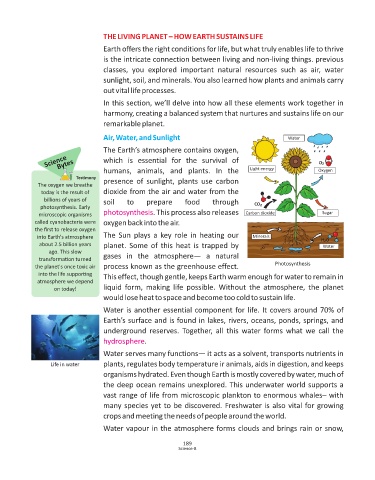
              The oxygen we breathe   presence  of  sunlight,  plants  use  carbon
               today is the result of   dioxide from the air and water from the
                billions of years of   soil   to    prepare      food     through
               photosynthesis. Early                                                     CO 2
              microscopic organisms   photosynthesis. This process also releases      Carbon dioxide            Sugar
             called cyanobacteria were   oxygen back into the air.
             the first to release oxygen
              into Earth's atmosphere   The Sun plays a key role in heating our         Minerals
                                                                                                                H O
                                                                                                                 2
               about 2.5 billion years   planet.  Some  of  this  heat  is  trapped  by                          Water
                  ago. This slow
               transforma on turned   gases  in  the  atmosphere—  a  natural
             the planet's once toxic air   process known as the greenhouse effect.              Photosynthesis
              into the life suppor ng   This effect, though gentle, keeps Earth warm enough for water to remain in
              atmosphere we depend
                    on today!        liquid  form,  making  life  possible.  Without  the  atmosphere,  the  planet
                                     would lose heat to space and become too cold to sustain life.

                                     Water is another essential component for life. It covers around 70% of
                                     Earth’s surface and is found in lakes, rivers, oceans, ponds, springs, and
                                     underground  reserves.  Together,  all  this  water  forms  what  we  call  the

                                     hydrosphere.

                                     Water serves many functions— it acts as a solvent, transports nutrients in
                   Life in water     plants, regulates body temperature ir animals, aids in digestion, and keeps
                                     organisms hydrated. Even though Earth is mostly covered by water, much of
                                     the deep ocean remains unexplored. This underwater world supports a
                                     vast range of life from microscopic plankton to enormous whales– with

                                     many species yet to be discovered. Freshwater is also vital for growing
                                     crops and meeting the needs of people around the world.

                                     Water vapour in the atmosphere forms clouds and brings rain or snow,

                                                                189
                                                               Science-8

