


Page 193 - Innovator's Science-8
P. 193
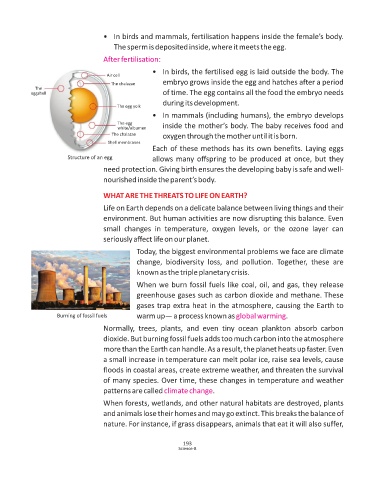
•  In birds and mammals, fertilisation happens inside the female’s body.
                                        The sperm is deposited inside, where it meets the egg.

                                     After fertilisation:

                                                      •  In birds, the fertilised egg is laid outside the body. The
                                      Air cell
                                                         embryo grows inside the egg and hatches after a period
                                       The chalazae
             The
            eggshell                                     of time. The egg contains all the food the embryo needs
                                                         during its development.
                                          The egg yolk
                                                      •  In mammals (including humans), the embryo develops
                                          The egg        inside the mother’s body. The baby receives food and
                                          white/albumen
                                        The chalazae     oxygen through the mother until it is born.
                                      Shell membranes
                                                      Each of these methods has its own benefits. Laying eggs
                        Structure of an egg           allows many offspring to be produced at once, but they

                                     need protection. Giving birth ensures the developing baby is safe and well-
                                     nourished inside the parent’s body.

                                     WHAT ARE THE THREATS TO LIFE ON EARTH?

                                     Life on Earth depends on a delicate balance between living things and their
                                     environment. But human activities are now disrupting this balance. Even
                                     small  changes  in  temperature,  oxygen  levels,  or  the  ozone  layer  can

                                     seriously affect life on our planet.

                                                Today, the biggest environmental problems we face are climate
                                                change,  biodiversity  loss,  and  pollution.  Together,  these  are
                                                known as the triple planetary crisis.

                                                When we burn fossil fuels like coal, oil, and gas, they release
                                                greenhouse gases such as carbon dioxide and methane. These
                                                gases trap extra heat in the atmosphere, causing the Earth to

                     Burning of fossil fuels    warm up— a process known as global warming          .
                                     Normally,  trees,  plants,  and  even  tiny  ocean  plankton  absorb  carbon
                                     dioxide. But burning fossil fuels adds too much carbon into the atmosphere
                                     more than the Earth can handle. As a result, the planet heats up faster. Even

                                     a small increase in temperature can melt polar ice, raise sea levels, cause
                                     floods in coastal areas, create extreme weather, and threaten the survival
                                     of many species. Over time, these changes in temperature and weather

                                     patterns are called climate change    .
                                     When forests, wetlands, and other natural habitats are destroyed, plants
                                     and animals lose their homes and may go extinct. This breaks the balance of

                                     nature. For instance, if grass disappears, animals that eat it will also suffer,


                                                                193
                                                               Science-8

