


Page 192 - Innovator's Science-8
P. 192
You might wonder: if both parents pass on their genetic material, wouldn’t
                                     the  new  organism  end  up  with  double  the  information?  This  doesn’t

                                     happen because each parent produces special reproductive cells, called
                                     gametes, that carry only half the genetic material.
                                     •  Male gametes (like sperm or pollen)

                                     •  Female gametes (like eggs or ovules)

                                     When  the  male  and  female  gametes  unite,  they  form  a  zygote  with  a
                                     complete set of genetic instructions— half from each parent.

                                     This mix of genetic material explains why babies don’t look exactly like
                                     either parent. Each child gets a unique combination of traits like eye colour,
                                     hair type, and height. Even siblings can look different depending on how

                                     the genes combine.
                                     Sexual Reproduction in Plants: In flowering plants, reproduction happens
                                     through specific parts of the flower:

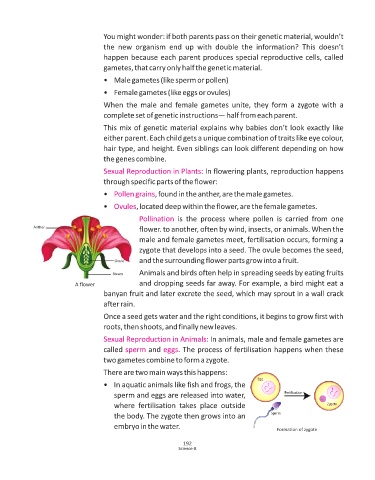
                                     •  Pollen grains  , found in the anther, are the male gametes.

                                     •  Ovules  , located deep within the flower, are the female gametes.
                                                 Pollination  is  the  process  where  pollen  is  carried  from  one

                                                 flower. to another, often by wind, insects, or animals. When the
             Anther
                                                 male and female gametes meet, fertilisation occurs, forming a
                                                 zygote that develops into a seed. The ovule becomes the seed,

                                         Ovule   and the surrounding flower parts grow into a fruit.

                                        Steam    Animals and birds often help in spreading seeds by eating fruits
                           A flower              and dropping seeds far away. For example, a bird might eat a
                                     banyan fruit and later excrete the seed, which may sprout in a wall crack

                                     after rain.

                                     Once a seed gets water and the right conditions, it begins to grow first with
                                     roots, then shoots, and finally new leaves.
                                     Sexual Reproduction in Animals: In animals, male and female gametes are

                                     called sperm   and eggs   . The process of fertilisation happens when these
                                     two gametes combine to form a zygote.

                                     There are two main ways this happens:
                                     •  In aquatic animals like fish and frogs, the
                                        sperm and eggs are released into water,

                                        where  fertilisation  takes  place  outside
                                        the body. The zygote then grows into an
                                        embryo in the water.
                                                                                                 Formation of zygote

                                                                192
                                                               Science-8

