


Page 187 - Innovator's Science-8
P. 187
scenario would make it nearly impossible for most life forms–including
                                     humans, animals, and plants–to survive.

                                     While  certain  microorganisms  like  some  bacteria  can  exist  in  icy
                                     environments, scientific evidence so far shows that liquid water is essential
                                     for life to originate and thrive. Earth’s location lets water exist mostly as a

                                     liquid, which is crucial for all forms of life.
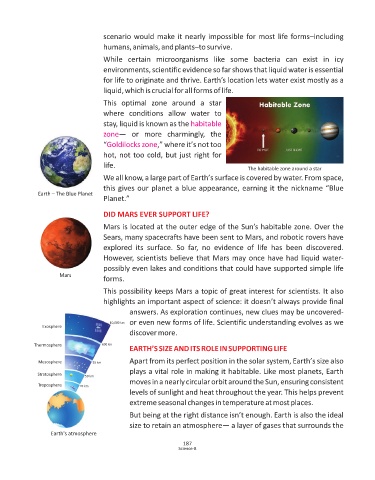
                                     This  optimal  zone  around  a  star

                                     where  conditions  allow  water  to
                                     stay, liquid is known as the habitable
                                     zone—  or  more  charmingly,  the
                                     “Goldilocks zone  ,” where it’s not too

                                     hot, not too cold, but just right for
                                     life.
                                                                                       The habitable zone around a star
                                     We all know, a large part of Earth’s surface is covered by water. From space,
                                     this gives our planet a blue appearance, earning it the nickname “Blue
              Earth – The Blue Planet
                                     Planet.”


                                     DID MARS EVER SUPPORT LIFE?
                                     Mars is located at the outer edge of the Sun’s habitable zone. Over the
                                     Sears, many spacecrafts have been sent to Mars, and robotic rovers have

                                     explored  its  surface.  So  far,  no  evidence  of  life  has  been  discovered.
                                     However, scientists believe that Mars may once have had liquid water-
                                     possibly even lakes and conditions that could have supported simple life
                      Mars
                                     forms.
                                     This possibility keeps Mars a topic of great interest for scientists. It also
                                     highlights an important aspect of science: it doesn’t always provide final
                                              answers. As exploration continues, new clues may be uncovered-

                                       10,000 km  or even new forms of life. Scientific understanding evolves as we
                Exosphere
                                              discover more.

             Thermosphere           690 km
                                              EARTH’S SIZE AND ITS ROLE IN SUPPORTING LIFE

              Mesosphere         85 km        Apart from its perfect position in the solar system, Earth’s size also
                                              plays a vital role in making it habitable. Like most planets, Earth
              Stratosphere
                              50 km
                                              moves in a nearly circular orbit around the Sun, ensuring consistent
              Troposphere    20 km
                                              levels of sunlight and heat throughout the year. This helps prevent
                                              extreme seasonal changes in temperature at most places.

                                              But being at the right distance isn’t enough. Earth is also the ideal
                                              size to retain an atmosphere— a layer of gases that surrounds the
                   Earth's atmosphere
                                                                187
                                                               Science-8

