


Page 190 - Innovator's Science-8
P. 190
helping  to  refill  lakes,  rivers,  and  underground  water.  Rainfall  patterns
                                     affect what types of plants and animals can survive in different regions.

                                     Moving wind plays a major role in weather and rainfall, directly influencing
                                     agriculture and life on land.

                                     Soil, Rocks, and Minerals

                                     Beneath  the  surface  lies  the  Earth’s  crust,  made  up  of  rocks,  soil,  and
                                     minerals.  Although  it  may  appear  lifeless,  this  layer  provides  almost
                                     everything needed for survival. It supports ecosystems and human life by
                                     offering resources like fertile soil, minerals, metals, coal, oil, and natural
                                     gas. This solid part of Earth is known as the geosphere    .

                     Rocks
                                     Soil may seem like simple dirt, but it contains nutrients such as nitrogen and
                                     potassium, which plants need to grow. These nutrients come from the

                                     breakdown of rocks and the remains of dead plants and animals over time.
                                              The Earth features a wide variety of landforms, rock types, and soil
                                              compositions. This natural variety, called geodiversity    , helps create

                                              different  habitats  where  a  wide  range  of  life  forms  can  thrive.
                                              These non-living components— rocks, soil, and water— are more
                                              than just a background; they play an active role in shaping and

                                              supporting life.
                      Geodiversity
                                     Plants, Animals, and Microorganisms

                                     Life on Earth is incredibly diverse. From massive trees and animals to tiny
                                     insects and microscopic organisms, the planet is full of living beings. All
                                     these forms of life, along with their environments, make up the biosphere.
                                     The  biosphere  includes  land,  water,  and  air—  spaces  where  living

                                     organisms interact with each other and their surroundings to survive and
                                     grow.  Life  is  deeply  interconnected.  Plants  use  sunlight  to  make  food,
                 Microorganisms      animals rely on plants or other animals for energy, and decomposers like
                                     fungi and bacteria break down waste and dead matter, returning nutrients

                                     to  the  soil.  This  cycle  ensures  that  energy  and  matter  flow  through
                                     ecosystems in a balanced way.

                                              The Importance of Balance

                                              Earth functions as a single, interconnected system– where land, air,
                                              water, and living organisms all influence one another. Everything is
                                              connected,  and  balance  is  the  key.  For  example,  cutting  down
                                              forests can reduce rainfall, damage soil quality, and disturb wildlife
                                              habitats.

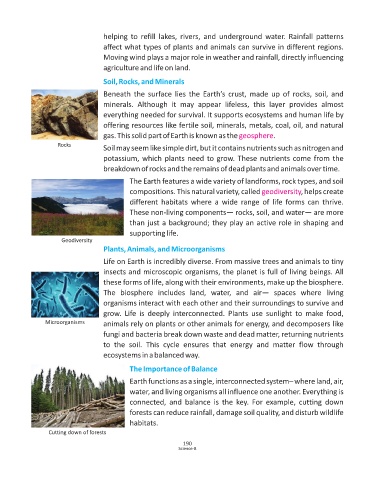
                  Cutting down of forests
                                                                190
                                                               Science-8

