


Page 191 - Innovator's Science-8
P. 191
Life thrives on Earth not because of one factor alone, but because many
                                     systems work together in harmony. This balance keeps the planet suitable

                                     for life. That’s why it is so important to protect our natural resources-clean
                                     air, fresh water, healthy soil, and all forms of life. Preserving this balance is
                                     essential for keeping Earth a safe and liveable home for generations to
                                     come.

                                     Asexual Reproduction

                                     Many plants have the ability to grow new plants from parts like leaves,
                                     stems, or roots. This type of reproduction, which does not require seeds, is
                                     called vegetative propagation.


                     Activity-3       Aim: To explore plant growth without seeds.
                                      Procedure:
                  Experiential Learning
                                      •  Collect parts of plants such as a stem cu ng of a money
                                          plant, a sprouted potato with 'eyes', or a piece of ginger.

                                      •  Plant  them  separately  in  moist  soil.  For  the  money
                                          plant, place the cu ng in a glass container filled with
                                          water so it's easy to observe.                          Vegeta ve propaga on—
                                                                                                   (a) Ginger; (b) Patoto
                                      •  Make sure they get enough air, sunlight, and water.
                                      •  Observe daily and note when roots, shoots, and new leaves start to grow.

                                     This simple method of growing plants is a form of asexual reproduction            ,

                                     where only one parent is involved, and the new plant is genetically identical
                                     to it.

                                     But it is not just plants— many simple organisms also reproduce this way.
                                     For example:

                                     •  Bacteria and amoeba (single-celled organisms) divide into two identical
                                        cells.

                                     •  Algae can grow from small broken pieces.
                                     •  Hydra,  a  tiny  aquatic  animal,  grows  small  buds  on  its  body  that
                                        eventually detach and form new individuals.
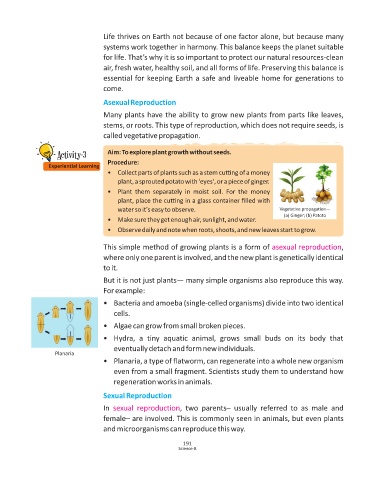
                    Planaria
                                     •  Planaria, a type of flatworm, can regenerate into a whole new organism
                                        even from a small fragment. Scientists study them to understand how

                                        regeneration works in animals.
                                     Sexual Reproduction

                                     In  sexual  reproduction  ,  two  parents–  usually  referred  to  as  male  and

                                     female– are involved. This is commonly seen in animals, but even plants
                                     and microorganisms can reproduce this way.

                                                                191
                                                               Science-8

