


Page 47 - Innovator's Science-8
P. 47
•  Connect the second wire between the cell holder and the switch
                                      •  Place the magne c compass beneath the wire between the two nails.
                                      When you turn the switch to the ON posi on, electric current starts flowing through
                                      the wire, You will no ce that the compass needle moves or gets deflected from its
                                      usual direc on. This happens because the electric current in the wire creates an
                                      invisible force around it called a magne c field, which acts on the magne c needle
                                      of the compass. When you turn the switch OFF and the current stops flowing, the
                                      magne c field disappears, and the compass needle goes back to poin ng in its
                                      original direc on. So, the movement of the compass needle shows that an electric
                                      current can produce a magne c effect around the wire.

                                      Conclusion: When electric current flows through a conductor (like a wire), it produces
                                      a magne c field around it. This phenomenon is known as the magne c effect of
                                      electric current. The magne c field disappears when the current stops flowing.
                 Science
                     Bytes


                           Testimony
             You have just now made the same discovery which was made by the scien st Hans Chris an Oersted (1777–1851) in 1820, that is, that
             electricity and magne sm are linked. He was a professor at a university in Denmark. It is said that once while giving a demonstra on,
             he no ced that whenever an electrical circuit was closed or opened, the needle of a magne c compass, lying nearby, deflected. He
             inves gated this and when he was certain that an electric current indeed produced a magne c field, he published his findings. This led
             to other scien sts repea ng his experiment to check if they got the same results, and further inves ga ng the connec on between
             electricity and magne sm.
             The magne c effect of electric current has many prac cal applica ons, such as in devices like electromagnets, electric bells, motors,
             fans, loudspeakers, and more.


                                     ELECTROMAGNETS
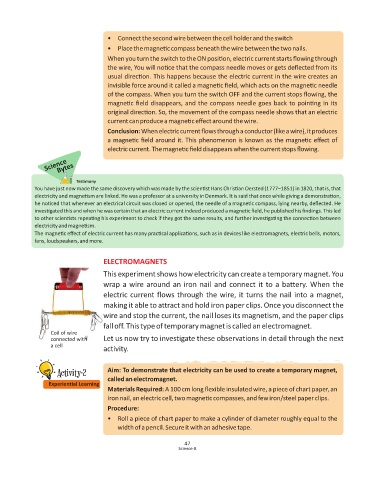
                                     This experiment shows how electricity can create a temporary magnet. You
                                     wrap a wire around an iron nail and connect it to a battery. When the

                                     electric current flows through the wire, it turns the nail into a magnet,
                                     making it able to attract and hold iron paper clips. Once you disconnect the
                                     wire and stop the current, the nail loses its magnetism, and the paper clips

                                     fall off. This type of temporary magnet is called an electromagnet.
                   Coil of wire
                   connected with    Let us now try to investigate these observations in detail through the next
                   a cell
                                     activity.


                     Activity-2       Aim: To demonstrate that electricity can be used to create a temporary magnet,
                                      called an electromagnet.
                  Experiential Learning
                                      Materials Required: A 100 cm long flexible insulated wire, a piece of chart paper, an
                                      iron nail, an electric cell, two magne c compasses, and few iron/steel paper clips.
                                      Procedure:

                                      •  Roll a piece of chart paper to make a cylinder of diameter roughly equal to the
                                          width of a pencil. Secure it with an adhesive tape.

                                                                 47
                                                               Science-8

