


Page 50 - Innovator's Science-8
P. 50
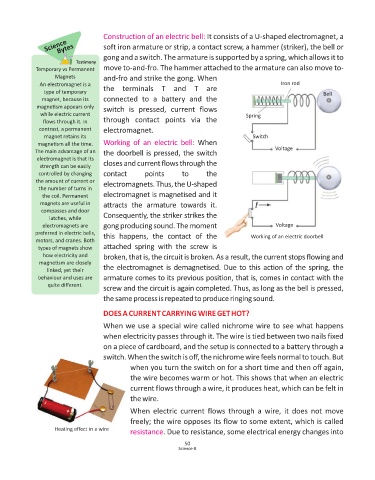
Construction of an electric bell: It consists of a U-shaped electromagnet, a
                 Science             soft iron armature or strip, a contact screw, a hammer (striker), the bell or
                     Bytes

                                     gong and a switch. The armature is supported by a spring, which allows it to
                           Testimony
             Temporary vs Permanent   move to-and-fro. The hammer attached to the armature can also move to-
                    Magnets          and-fro and strike the gong. When
               An electromagnet is a                                                              Iron rod
                type of temporary    the  terminals  T  and  T  are                                              Bell
               magnet, because its   connected  to  a  battery  and  the
              magne sm appears only   switch  is  pressed,  current  flows
               while electric current                                                 Spring
                flows through it. In   through  contact  points  via  the
               contrast, a permanent   electromagnet.
                magnet retains its                                                      Switch
              magne sm all the  me.   Working  of  an  electric  bell:  When
                                                                                                Voltage
             The main advantage of an   the doorbell is pressed, the switch
              electromagnet is that its
               strength can be easily   closes and current flows through the
              controlled by changing   contact     points       to      the
             the amount of current or   electromagnets. Thus, the U-shaped
              the number of turns in
                the coil. Permanent   electromagnet is magnetised and it
               magnets are useful in   attracts  the  armature  towards  it.
               compasses and door
                  latches, while     Consequently, the striker strikes the
                electromagnets are   gong producing sound. The moment                           Voltage
             preferred in electric bells,   this  happens,  the  contact  of  the       Working of an electric doorbell
             motors, and cranes. Both
              types of magnets show   attached  spring  with  the  screw  is
                how electricity and   broken, that is, the circuit is broken. As a result, the current stops flowing and
               magne sm are closely
                 linked, yet their   the electromagnet is demagnetised. Due to this action of the spring, the
              behaviour and uses are   armature comes to its previous position, that is, comes in contact with the
                  quite different.
                                     screw and the circuit is again completed. Thus, as long as the bell is pressed,
                                     the same process is repeated to produce ringing sound.

                                     DOES A CURRENT CARRYING WIRE GET HOT?

                                     When we use a special wire called nichrome wire to see what happens
                                     when electricity passes through it. The wire is tied between two nails fixed
                                     on a piece of cardboard, and the setup is connected to a battery through a
                                     switch. When the switch is off, the nichrome wire feels normal to touch. But
                                              when you turn the switch on for a short time and then off again,

                                              the wire becomes warm or hot. This shows that when an electric
                                              current flows through a wire, it produces heat, which can be felt in
                                              the wire.

                                              When  electric  current  flows  through  a  wire,  it  does  not  move
                                              freely; the wire opposes its flow to some extent, which is called
                    Heating effect in a wire
                                              resistance. Due to resistance, some electrical energy changes into
                                                                 50
                                                               Science-8

