


Page 51 - Innovator's Science-8
P. 51
heat  energy, making the  wire warm. Different  materials have different
                                     amounts of resistance. For example, nichrome wire has more resistance
                 Science             than copper wire of the same size and length, so it becomes hotter when
                     Bytes


                           Testimony  current passes through it. This process, where a conductor gets heated by
                                     the  flow  of  electric  current,  is  known  as  the  heating  effect  of  electric
                 Electric Bulb and
                Fluorescent Lamp     current.
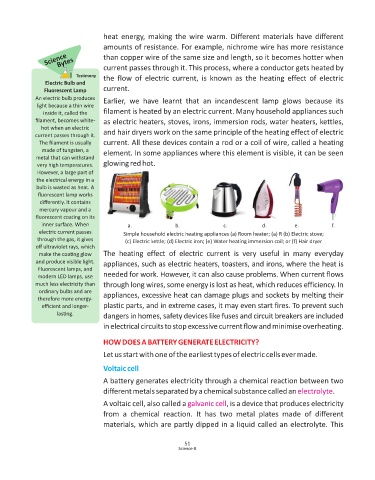
             An electric bulb produces   Earlier,  we  have  learnt  that  an  incandescent  lamp  glows  because  its
              light because a thin wire
                inside it, called the   filament is heated by an electric current. Many household appliances such
             filament, becomes white-  as electric heaters, stoves, irons, immersion rods, water heaters, kettles,
               hot when an electric
             current passes through it.   and hair dryers work on the same principle of the heating effect of electric
               The filament is usually   current. All these devices contain a rod or a coil of wire, called a heating
               made of tungsten, a   element. In some appliances where this element is visible, it can be seen
             metal that can withstand
              very high temperatures.   glowing red hot.
              However, a large part of
              the electrical energy in a
              bulb is wasted as heat. A
              fluorescent lamp works
               differently. It contains
               mercury vapour and a
             fluorescent coa ng on its
               inner surface. When           a.               b.              c.            d.         e.           f.
              electric current passes       Simple household electric heating appliances (a) Room heater; (a) R (b) Electric stove;
              through the gas, it gives     (c) Electric kettle; (d) Electric iron; (e) Water heating immersion coil; or (f) Hair dryer
             off ultraviolet rays, which
              make the coa ng glow   The  heating  effect  of  electric  current  is  very  useful  in  many  everyday
             and produce visible light.   appliances, such as electric heaters, toasters, and irons, where the heat is
              Fluorescent lamps, and
              modern LED lamps, use   needed for work. However, it can also cause problems. When current flows
             much less electricity than   through long wires, some energy is lost as heat, which reduces efficiency. In
              ordinary bulbs and are   appliances, excessive heat can damage plugs and sockets by melting their
              therefore more energy-
               efficient and longer-   plastic parts, and in extreme cases, it may even start fires. To prevent such
                     las ng.         dangers in homes, safety devices like fuses and circuit breakers are included

                                     in electrical circuits to stop excessive current flow and minimise overheating.

                                     HOW DOES A BATTERY GENERATE ELECTRICITY?

                                     Let us start with one of the earliest types of electric cells ever made.

                                     Voltaic cell
                                     A battery generates electricity through a chemical reaction between two

                                     different metals separated by a chemical substance called an electrolyte       .
                                     A voltaic cell, also called a galvanic cell , is a device that produces electricity
                                     from  a  chemical  reaction.  It  has  two  metal  plates  made  of  different

                                     materials, which are partly dipped in a liquid called an electrolyte. This


                                                                 51
                                                               Science-8

