


Page 53 - Innovator's Science-8
P. 53
connected to the negative terminal of the battery]. A glowing LED indicates
                                     that your cell is working. In this cell, the metal electrodes are the copper

                                     wires and the iron nails. The electrolyte is the lemon juice, which helps
                                     conduct electricity. You may also use salt solutions instead of lemon juice.
                                     Some common metal pairs for Voltaic cells are zinc/copper, zinc/ silver,

                                     aluminium/copper,  iron/copper,  magnesium/copper,  and  lead/copper.
                                     Some metals such as copper act as positive electrodes, while others like
                                     zinc act as negative electrodes. This is due to their chemical properties. We

                                     will learn more about this in the higher grades.
                                     Dry Cells

                                     Voltaic cells were a great scientific discovery, but they are not practical for
                                     everyday use because they contain liquid electrolytes. In modern times,

                                     dry cells are commonly used instead. They are called “dry” because their
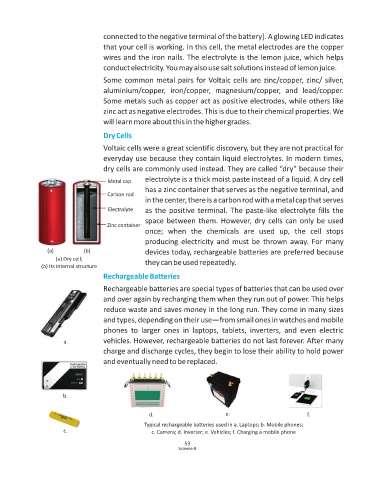
                                      Metal cap    electrolyte is a thick moist paste instead of a liquid. A dry cell
                                                   has a zinc container that serves as the negative terminal, and
                                      Carbon rod
                                                   in the center, there is a carbon rod with a metal cap that serves

                                      Electrolyte  as the positive terminal. The paste-like electrolyte fills the
                                                   space between them. However, dry cells can only be used
                                      Zinc container
                                                   once;  when  the  chemicals  are  used  up,  the  cell  stops
                                                   producing  electricity  and  must  be  thrown  away.  For  many

                 (a)          (b)                  devices today, rechargeable batteries are preferred because
                    (a) Dry cell;                  they can be used repeatedly.
               (b) Its internal structure
                                     Rechargeable Batteries

                                     Rechargeable batteries are special types of batteries that can be used over
                                     and over again by recharging them when they run out of power. This helps
                                     reduce waste and saves money in the long run. They come in many sizes
                                     and types, depending on their use—from small ones in watches and mobile
                                     phones  to  larger  ones  in  laptops,  tablets,  inverters,  and  even  electric

                       a.            vehicles. However, rechargeable batteries do not last forever. After many
                                     charge and discharge cycles, they begin to lose their ability to hold power
                                     and eventually need to be replaced.


                       b.


                                                     d.                        e.                          f.
                                                   Typical rechargeable batteries used in a. Laptops; b. Mobile phones;
                       c.                            c. Camera; d. Inverter; e. Vehicles; f. Charging a mobile phone

                                                                 53
                                                               Science-8

