


Page 101 - Social Science 2_flatten
P. 101
Our  Constitution  was  accepted  on  26

            January, 1950. We celebrate this day as
            Republic Day.

            Our  Constitution  lays  down  some
            important guiding principles that have to

            be followed by the leaders of our nation.
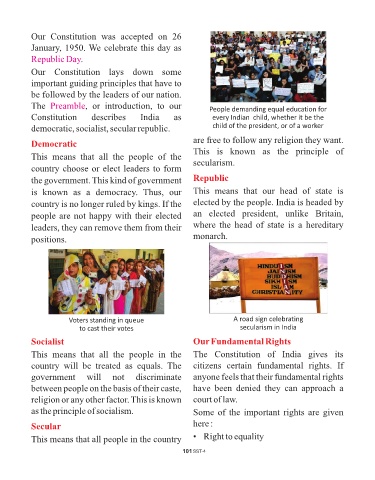
            The  Preamble      ,  or  introduction,  to  our             People demanding equal education for
            Constitution         describes        India      as           every Indian  child, whether it be the


            democratic,socialist, secular republic.                        child of the president, or of a worker
                                                                    are free to follow any religion they want.
            Democratic
                                                                    This  is  known  as  the  principle  of
            This  means  that  all  the  people  of  the
                                                                    secularism.
            country choose or elect leaders to form
            the government. This kind of government                 Republic

            is  known  as  a  democracy.  Thus,  our                This  means  that  our  head  of  state  is
            country is no longer ruled by kings. If the             elected by the people. India is headed by

            people are not happy with their elected                 an  elected  president,  unlike  Britain,
            leaders, they can remove them from their                where  the  head  of  state  is  a  hereditary
                                                                    monarch.
            positions.


                         Voters standing in queue                                 A road sign celebrating
                            to cast their votes                                     secularism in India

            Socialist                                               Our Fundamental Rights

            This  means  that  all  the  people  in  the            The  Constitution  of  India  gives  its
            country  will  be  treated  as  equals.  The            citizens  certain  fundamental  rights.  If
            government  will  not  discriminate  anyone feels that their fundamental rights

            between people on the basis of their caste,             have  been  denied  they  can  approach  a
            religion or any other factor. This is known             court of law.

            as the principle of socialism.                          Some of the important rights are given

            Secular                                                 here :

            This means that all people in the country               •  Right to equality

                                                                101 SST-4

