


Page 96 - Social Science 2_flatten
P. 96
India in 1830 CE under the British rule. It             to God and away from worldly things.

            is used as an additional official language.

            Our Dresses
                                                                      Urdu, Sindhi and Kashmiri languages are
            People wear different types of dresses in                 wri en from right to le .
            different parts of the country. Saree is the
            most  popular  dress  of  women.  Salwar-
                                                                    There are two styles of classical music:
            kameez, lehanga-choli, skirt-blouse and                 Hindustani in North India and         Carnatic in
            odhani  are  other  common  dresses  for
                                                                    South  India.  Different  instruments  are
            women. Kurta-dhoti, lungi, shirt-trousers               used      in    classical
            and  pyjama-kurta  are  common  dresses                 music. Sitar, santoor,

            for men.                                                violin,  veena,  flute,

                                                                    sarod, shehnai, tabla,
                                                                    mridangam             and

                                                                    dholak are among the
                                                                    popular ones.                   Pt. Ravi Shankar

                                                                    Dances in India can be divided into two
                                                                    forms,  namely,  folk  dance       and  classical

                                                                    dance.  Most  folk  dances  are  performed
                               A cloth shop
                                                                    during  festivals  and  ceremonies.  Most
            People choose their dresses according to                classical  dances  are  connected  with  the

            the  climatic  conditions.  Cotton  is  the             temples  of  India  and  are  based  on  the
            most  suitable  wear  in  summer  and                   Hindu epics. Some  famous folk dances are

            woollens in winter.                                     Bhangra of Punjab,      Ghoomar of Rajasthan,

            Music and Dance                                         Garba  of  Gujarat  and        Bihu  of  Assam.
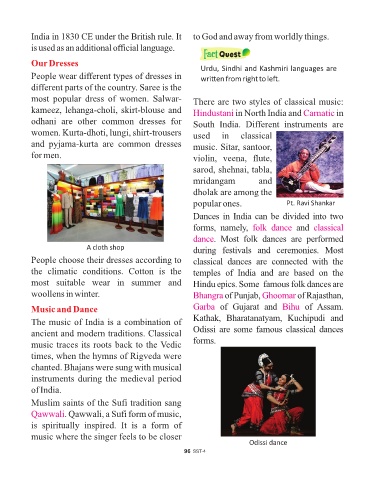
                                                                    Kathak,  Bharatanatyam,  Kuchipudi  and
            The music of India is a combination of
                                                                    Odissi are some famous classical dances
            ancient and modern traditions. Classical
                                                                    forms.
            music traces its roots back to the Vedic
            times, when the hymns of Rigveda were
            chanted. Bhajans were sung with musical

            instruments during the medieval period
            of India.

            Muslim saints of the Sufi tradition sang
            Qawwali. Qawwali, a Sufi form of music,

            is  spiritually  inspired.  It  is  a  form  of
            music where the singer feels to be closer
                                                                                       Odissi dance
                                                                 96 SST-4

