


Page 106 - Journeys Through Society-7
P. 106
area in the northern half of the continent of South     The  mighty  Amazon  river  and  its  tributaries  flow
            America and are called selvas.                          through the forest, providing a vital transport route.
            The Amazon rainforests are rich in wildlife. Among the   They are an important source of water for the native
            animals  found  here  are:  tree-dwelling  sloths  and   people, who live in the forest villages.
            various  types  of  monkeys,  ground-dwelling  tapirs,
            anteaters and armadilos, and many species of bats,
            including blood-drinking vampires. Large cats like the
            jaguar  and  ocelot  are  now  rare,  but  pumas  are
            common around the Andes. Colourful birds such as
            toucans, hummingbirds and parrots are found as are
            various types of ants, mosquitoes, flies, centipedes,
            scorpions,  giant  spiders  and  brightly  coloured
            butterflies. Among the reptiles found are crocodiles,
            iguanas  (large  lizards)  and  huge  snakes  like  the
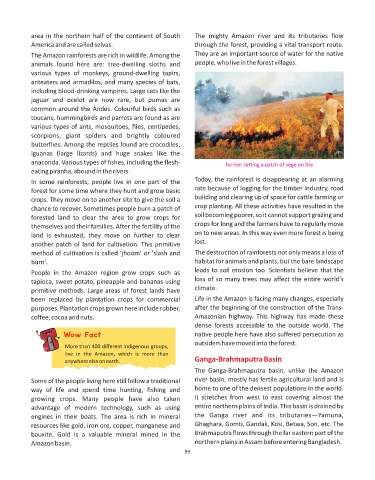
            anaconda. Various types of fishes, including the flesh-            Farmer setting a patch of vege on fire
            eating piranha, abound in the rivers.
            In  some  rainforests,  people  live  in  one  part  of  the   Today, the rainforest is disappearing at an alarming
                                                                    rate because of logging for the timber industry, road
            forest for some time where they hunt and grow basic
            crops. They move on to another site to give the soil a   building and clearing up of space for cattle farming or
                                                                    crop planting. All these activities have resulted in the
            chance to recover. Sometimes people burn a patch of
                                                                    soil becoming poorer, so it cannot support grazing and
            forested  land  to  clear  the  area  to  grow  crops  for
            themselves and their families. After the fertility of the   crops for long and the farmers have to regularly move
                                                                    on to new areas. In this way even more forest is being
            land  is  exhausted,  they  move  on  further  to  clear
            another patch of land for cultivation. This primitive   lost.
            method of cultivation is called ‘jhoom’ or 'slash and   The destruction of rainforests not only means a loss of
            burn'.                                                  habitat for animals and plants, but the bare landscape
            People  in  the  Amazon  region  grow  crops  such  as   leads to soil erosion too. Scientists believe that the
            tapioca, sweet potato, pineapple and bananas using      loss of so many trees may affect the entire world's
                                                                    climate.
            primitive methods. Large areas of forest lands have
            been  replaced  by  plantation  crops  for  commercial   Life in the Amazon is facing many changes, especially
            purposes. Plantation crops grown here include rubber,   after the beginning of the construction of the Trans-
            coffee, cocoa and nuts.                                 Amazonian  highway.  This  highway  has  made  these
                                                                    dense  forests  accessible  to  the  outside  world.  The
                       Wow Fact                                     native people here have also suffered persecution as
                                                                    outsiders have moved into the forest.
                       More than 400 different indigenous groups,
                       live  in  the  Amazon,  which  is  more  than
                       anywhere else on earth.                      Ganga-Brahmaputra Basin
                                                                    The  Ganga-Brahmaputra  basin,  unlike  the  Amazon

            Some of the people living here still follow a traditional   river basin, mostly has fertile agricultural land and is
            way  of  life  and  spend  time  hunting,  fishing  and   home to one of the densest populations in the world.
            growing  crops.  Many  people  have  also  taken        It  stretches  from  west  to  east  covering  almost  the
            advantage  of  modern  technology,  such  as  using     entire northern plains of India. This basin is drained by
            engines  in  their  boats.  The  area  is  rich  in  mineral   the  Ganga  river  and  its  tributaries—Yamuna,
            resources like gold, iron ore, copper, manganese and    Ghaghara, Gomti, Gandak, Kosi, Betwa, Son, etc. The
            bauxite.  Gold  is  a  valuable  mineral  mined  in  the   Brahmaputra flows through the far eastern part of the
            Amazon basin.                                           northern plains in Assam before entering Bangladesh.
                                                                 99

