


Page 107 - Journeys Through Society-7
P. 107
industry,  etc.  Industrialisation  and  urbanisation  in
                                                                    some parts of this basin has opened ways for a whole
                                                                    range of economic activities for the people and helped
                                                                    in the development of the communities.


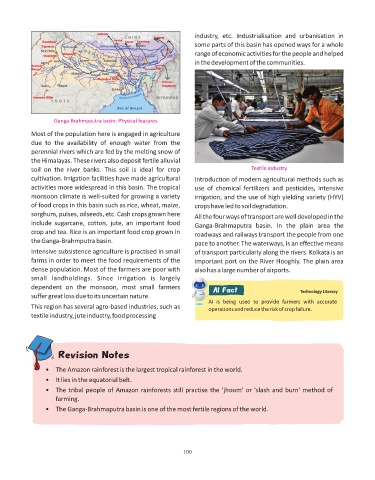
                    Ganga-Brahmaputra basin: Physical features
            Most of the population here is engaged in agriculture
            due  to  the  availability  of  enough  water  from  the
            perennial rivers which are fed by the melting snow of
            the Himalayas. These rivers also deposit fertile alluvial
            soil  on  the  river  banks.  This  soil  is  ideal  for  crop              Textile industry
            cultivation. Irrigation facilities have made agricultural   Introduction of modern agricultural methods such as
            activities more widespread in this basin. The tropical   use  of  chemical  fertilizers  and  pesticides,  intensive
            monsoon climate is well-suited for growing a variety    irrigation, and the use of high yielding variety (HYV)
            of food crops in this basin such as rice, wheat, maize,   crops have led to soil degradation.
            sorghum, pulses, oilseeds, etc. Cash crops grown here   All the four ways of transport are well developed in the
            include  sugarcane,  cotton,  jute,  an  important  food
                                                                    Ganga-Brahmaputra  basin.  In  the  plain  area  the
            crop and tea. Rice is an important food crop grown in   roadways and railways transport the people from one
            the Ganga-Brahmputra basin.
                                                                    pace to another. The waterways, is an effective means
            Intensive subsistence agriculture is practised in small   of transport particularly along the rivers. Kolkata is an
            farms in order to meet the food requirements of the     important port on the River Hooghly. The plain area
            dense population. Most of the farmers are poor with     also has a large number of airports.
            small  landholdings.  Since  irrigation  is  largely
            dependent  on  the  monsoon,  most  small  farmers             AI Fact
            suffer great loss due to its uncertain nature.                                               Technology Literacy
                                                                         AI  is  being  used  to  provide  farmers  with  accurate
            This region has several agro-based industries, such as       operations and reduce the risk of crop failure.
            textile industry, jute industry, food processing


                     Revision Notes


                 •  The Amazon rainforest is the largest tropical rainforest in the world.
                 •  It lies in the equatorial belt.
                 •  The tribal people of Amazon rainforests still practise the ‘jhoom’ or 'slash and burn' method of
                    farming.

                 •  The Ganga-Brahmaputra basin is one of the most fertile regions of the world.


                                                                100

