


Page 118 - Journeys Through Society-7
P. 118
of discrimination. The term 'equality' denotes not only   SOCIAL EQUALITY
            social status but equal opportunities and the equality
                                                                    Social equality is concerned with the distribution of
            of different religions. The Right to Equality is based on
                                                                    social  goods,  such  as  income,  wealth,  opportunity,
            the following basic principles:
                                                                    education and healthcare. Social equality would then
            •  All people are equal before law.                     mean  equal  opportunity  to  access  education  and
            •  No person can be discriminated on the basis of       healthcare.
               their religion, caste, race, gender or colour.       The most common form of social inequality in India is

            •  Every person has equal access to public places and   the  caste  system.  The  caste  system  is  an  ancient
               facilities like playgrounds, hotels, religious places,   practice of creating a hierarchy of status in society,
               shops, markets, parks, wells and canals.             where  fixed  social  roles  have  been  inherited  and
            •  Untouchability has been abolished. Anyone who        practised since ancient times. In urban India, the caste
               practises it can be punished under law.              system has weakened due to frequent intermingling
                                                                    of people. The Constitution of India has passed laws
            •  There  are  three  parameters  through  which
                                                                    that prohibit discrimination against people based on
               equality can be measured in any society.
                                                                    race, gender or caste. These ensure that people are
            POLITICAL EQUALITY                                      treated equally by employers, governments and other
                                                                    members of society. However, caste distinctions still
            Political equality means granting citizenship and equal
                                                                    play a divisive role in our society.
            rights to all members of the state, and also, ensuring
            conditions that allow the citizens to participate in the
            affairs  of  the  state.  This  is  made  possible  by  the
            Constitution, which gives every Indian who is 18 years
            of  age  and  above  the  right  to  vote.  This  right  is
            understood  as  the  Universal  Adult  Franchise.
            Universal Adult Franchise is an essential feature of all
            modern democracies, as it ensures political equality in
            the society. The implication of this is that everyone is
            equal. However, in reality not everyone is treated as
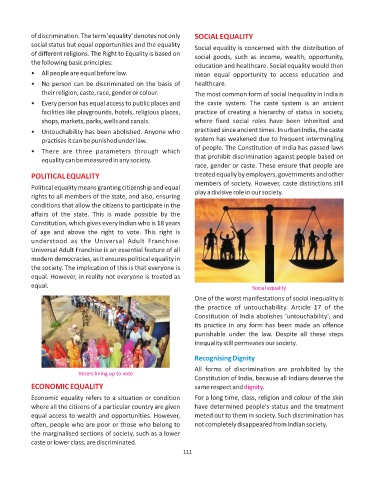
            equal.                                                                      Social equality

                                                                    One of the worst manifestations of social inequality is
                                                                    the  practice  of  untouchability.  Article  17  of  the
                                                                    Constitution of India abolishes 'untouchability', and
                                                                    its practice in any form has been made an offence
                                                                    punishable  under  the  law.  Despite  all  these  steps
                                                                    inequality still permeates our society.

                                                                    Recognising Dignity

                                                                    All  forms  of  discrimination  are  prohibited  by  the
                            Voters lining up to vote
                                                                    Constitution of India, because all Indians deserve the
            ECONOMIC EQUALITY                                       same respect and dignity .

            Economic equality refers to a situation or condition    For a long time, class, religion and colour of the skin
            where all the citizens of a particular country are given   have determined people's status and the treatment
            equal access to wealth and opportunities. However,      meted out to them in society. Such discrimination has
            often, people who are poor or those who belong to       not completely disappeared from Indian society.
            the marginalised sections of society, such as a lower
            caste or lower class, are discriminated.
                                                                111

