


Page 113 - Journeys Through Society-7
P. 113
herders and take care of flocks of goats, sheep, and    Previously  Ladakh  used  to  be  part  of  Jammu  and
            camels.                                                 Kashmir. In 2019, it became a separate Union Territory
            Nomadic herders like the Bedouins and Tuaregs live in   of  India.  Enclosed  by  the  Karakoram  Ranges  in  the
            tents so they can move easily as soon as all the grass is   north and Zanskar Mountains in the south, Ladakh is
            consumed by the cattle in one region. These animals     located in the lap of the Great Himalayas. Located at
            provide meat, milk and hide to the people. Hide is      altitudes of 3,000 metres to 8,000 metres, this Union
            used  for  making  water  bottles,  belts  and  slippers,   territory of India is characterised by lofty mountains
            while carpets, clothes and blankets are made from       and  arid  land.  Many  glaciers  can  be  found  here,
            animal hair.                                            including the Gangotri glacier, which is the source of
                                                                    the mighty river Ganga. The river Indus flows through
            People living a settled life in the Nile Valley and oasis
                                                                    the mountainous land.
            cultivate food crops like wheat, rice, barley, and beans.
            Cotton is an important cash crop grown here. Dates      Climate
            are  most  widely  grown  among  fruits,  apart  from
                                                                    Due to its great altitude, Ladakh has thin air, which
            olives, figs and apricots.
                                                                    allows the intense heat of the Sun to be felt. The cold,
            The  discovery  of  oil  has  helped  in  the  economic   dry  climate  of  Ladakh  is  harsh  during  the  winter
            development of the people and life in the Sahara is     season.  The  average  daily  temperature  in  January
            changing to become more modern.                         ranges between -30° at 6 a.m., -17° at noon and -24° at
                                                                    6 p.m. The average daily temperature in June ranges
                       Wow Fact                                     from -8° at 6 a.m., to 1° at noon and 2° at 6 p.m. The

                       The Sahara Desert’s singing sand dunes are   climate is wet in June with 100 mm of rainfall. Cold
                       phenomenon  that  have  left  researchers    frost  bites  are  common  during  the  inhospitable
                       stumped. The orchestral sounds the desert
                                                                    winters.
                       emit can range from sonic booms, drumming
                       and even whistling.                          Flora and Fauna
                                                                    Lying in the leeward side or rain shadow area of the
                                                                    Great Himalayas, Ladakh receives very little rainfall.
            Life in a Cold Desert
                                                                    The annual average rainfall is as low as 10 cm. This
            Ladakh                                                  makes the land arid with very little natural vegetation.
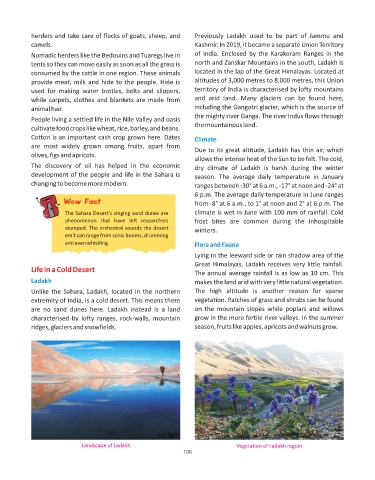
            Unlike  the  Sahara,  Ladakh,  located  in  the  northern   The  high  altitude  is  another  reason  for  sparse
            extremity of India, is a cold desert. This means there   vegetation. Patches of grass and shrubs can be found
            are  no  sand  dunes  here.  Ladakh  instead  is  a  land   on  the  mountain  slopes  while  poplars  and  willows
            characterised  by  lofty  ranges,  rock-walls,  mountain   grow in the more fertile river valleys. In the summer
            ridges, glaciers and snowfields.                        season, fruits like apples, apricots and walnuts grow.


                             Landscape of Ladakh                                   Vegetation of Ladakh region
                                                                106

