


Page 73 - Journeys Through Society-7
P. 73
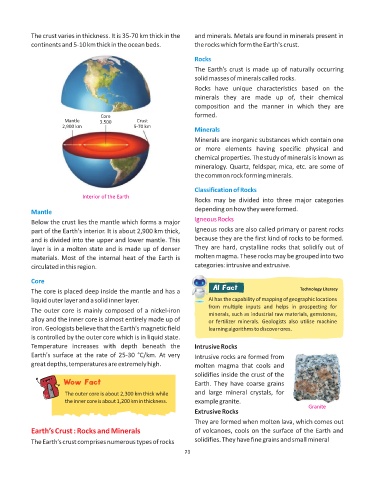
The crust varies in thickness. It is 35-70 km thick in the   and minerals. Metals are found in minerals present in
            continents and 5-10 km thick in the ocean beds.         the rocks which form the Earth's crust.

                                                                    Rocks
                                                                    The Earth’s crust is made up of naturally occurring
                                                                    solid masses of minerals called rocks.
                                                                    Rocks  have  unique  characteristics  based  on  the
                                                                    minerals  they  are  made  up  of,  their  chemical
                                                                    composition  and  the  manner  in  which  they  are

                                    Core                            formed.
                       Mantle      3.500        Crust
                       2,900 km                5-70 km
                                                                    Minerals
                                                                    Minerals are inorganic substances which contain one
                                                                    or  more  elements  having  specific  physical  and
                                                                    chemical properties. The study of minerals is known as
                                                                    mineralogy. Quartz, feldspar, mica, etc. are some of
                                                                    the common rock forming minerals.

                                                                    Classification of Rocks
                              Interior of the Earth
                                                                    Rocks  may  be  divided  into  three  major  categories
                                                                    depending on how they were formed.
            Mantle
                                                                    Igneous Rocks
            Below the crust lies the mantle which forms a major
            part of the Earth's interior. It is about 2,900 km thick,   Igneous rocks are also called primary or parent rocks
            and is divided into the upper and lower mantle. This    because they are the first kind of rocks to be formed.
            layer is in a molten state and is made up of denser     They  are  hard,  crystalline  rocks  that  solidify  out  of
            materials. Most of the internal heat of the Earth is    molten magma. These rocks may be grouped into two
            circulated in this region.                              categories: intrusive and extrusive.

            Core
                                                                           AI Fact
            The core is placed deep inside the mantle and has a                                          Technology Literacy
            liquid outer layer and a solid inner layer.                  AI has the capability of mapping of geographic locations
                                                                         from  multiple  inputs  and  helps  in  prospecting  for
            The outer core is mainly composed of a nickel-iron
                                                                         minerals, such as industrial raw materials, gemstones,
            alloy and the inner core is almost entirely made up of       or  fertilizer  minerals.  Geologists  also  utilise  machine
            iron. Geologists believe that the Earth's magnetic field     learning algorithms to discover ores.
            is controlled by the outer core which is in liquid state.
            Temperature  increases  with  depth  beneath  the       Intrusive Rocks
            Earth's  surface at  the  rate  of  25-30  °C/km. At  very   Intrusive rocks are formed from
            great depths, temperatures are extremely high.          molten  magma  that  cools  and
                                                                    solidifies inside the crust of the
                       Wow Fact                                     Earth.  They  have  coarse  grains

                       The outer core is about 2,300 km thick while   and  large  mineral  crystals,  for
                       the inner core is about 1,200 km in thickness.  example granite.
                                                                                                            Granite
                                                                    Extrusive Rocks
                                                                    They are formed when molten lava, which comes out
            Earth’s Crust : Rocks and Minerals                      of volcanoes, cools on the surface of the Earth and

            The Earth’s crust comprises numerous types of rocks     solidifies. They have fine grains and small mineral
                                                                 73

