


Page 75 - Journeys Through Society-7
P. 75
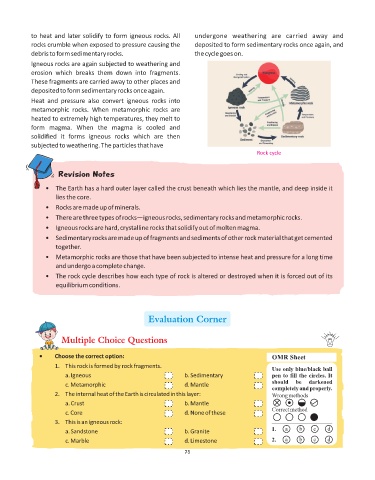
to heat and later solidify to form igneous rocks. All   undergone  weathering  are  carried  away  and
            rocks crumble when exposed to pressure causing the      deposited to form sedimentary rocks once again, and
            debris to form sedimentary rocks.                       the cycle goes on.
            Igneous rocks are again subjected to weathering and
            erosion  which  breaks  them  down  into  fragments.
            These fragments are carried away to other places and
            deposited to form sedimentary rocks once again.
            Heat  and  pressure  also  convert  igneous  rocks  into
            metamorphic  rocks.  When  metamorphic  rocks  are
            heated to extremely high temperatures, they melt to
            form  magma.  When  the  magma  is  cooled  and
            solidified  it  forms  igneous  rocks  which  are  then
            subjected to weathering. The particles that have
                                                                                          Rock cycle


                     Revision Notes


                 •  The Earth has a hard outer layer called the crust beneath which lies the mantle, and deep inside it
                    lies the core.
                 •  Rocks are made up of minerals.
                 •  There are three types of rocks—igneous rocks, sedimentary rocks and metamorphic rocks.
                 •  Igneous rocks are hard, crystalline rocks that solidify out of molten magma.

                 •  Sedimentary rocks are made up of fragments and sediments of other rock material that get cemented
                    together.

                 •  Metamorphic rocks are those that have been subjected to intense heat and pressure for a long time
                    and undergo a complete change.
                 •  The rock cycle describes how each type of rock is altered or destroyed when it is forced out of its
                    equilibrium conditions.


                                                    Evaluation Corner


                      Multiple Choice Questions

               •    Choose the correct option:                                                 OMR Sheet
                    1.  This rock is formed by rock fragments.
                                                                                               Use only blue/black ball
                        a. Igneous                               b. Sedimentary                pen to fill the circles. It
                                                                                               should   be   darkened
                        c. Metamorphic                           d. Mantle
                                                                                               completely and properly.
                    2.  The internal heat of the Earth is circulated in this layer:            Wrong methods
                        a. Crust                                 b. Mantle
                                                                                               Correct method
                        c. Core                                  d. None of these
                    3.  This is an igneous rock:
                        a. Sandstone                             b. Granite                    1.   a   b    c    d
                        c. Marble                                d. Limestone                  2.   a   b    c    d

                                                                 75

