


Page 74 - Journeys Through Society-7
P. 74
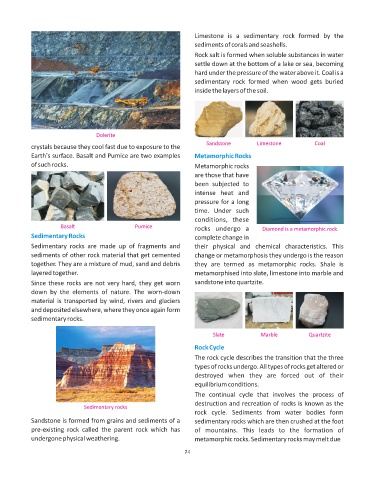
Limestone  is  a  sedimentary  rock  formed  by  the
                                                                    sediments of corals and seashells.
                                                                    Rock salt is formed when soluble substances in water
                                                                    settle down at the bottom of a lake or sea, becoming
                                                                    hard under the pressure of the water above it. Coal is a
                                                                    sedimentary  rock  formed  when  wood  gets  buried
                                                                    inside the layers of the soil.


                                  Dolerite
                                                                        Sandstone         Limestone           Coal
            crystals because they cool fast due to exposure to the
            Earth's surface. Basalt and Pumice are two examples     Metamorphic Rocks
            of such rocks.                                          Metamorphic rocks
                                                                    are those that have
                                                                    been  subjected  to
                                                                    intense  heat  and
                                                                    pressure for a long
                                                                    time.  Under  such
                                                                    conditions,  these
                      Basalt                    Pumice              rocks  undergo  a       Diamond is a metamorphic rock.
            Sedimentary Rocks                                       complete change in
            Sedimentary  rocks  are  made  up  of  fragments  and   their  physical  and  chemical  characteristics.  This
            sediments of other rock material that get cemented      change or metamorphosis they undergo is the reason
            together. They are a mixture of mud, sand and debris    they  are  termed  as  metamorphic  rocks.  Shale  is
            layered together.                                       metamorphised into slate, limestone into marble and
            Since these rocks are not very hard, they get worn      sandstone into quartzite.
            down  by  the  elements  of  nature.  The  worn-down
            material is transported by wind, rivers and glaciers
            and deposited elsewhere, where they once again form
            sedimentary rocks.


                                                                           Slate           Marble           Quartzite
                                                                    Rock Cycle
                                                                    The rock cycle describes the transition that the three
                                                                    types of rocks undergo. All types of rocks get altered or
                                                                    destroyed  when  they  are  forced  out  of  their
                                                                    equilibrium conditions.
                                                                    The  continual  cycle  that  involves  the  process  of
                                                                    destruction and recreation of rocks is known as the
                              Sedimentary rocks
                                                                    rock  cycle.  Sediments  from  water  bodies  form
            Sandstone is formed from grains and sediments of a      sedimentary rocks which are then crushed at the foot
            pre-existing  rock  called  the  parent  rock  which  has   of  mountains.  This  leads  to  the  formation  of
            undergone physical weathering.                          metamorphic rocks. Sedimentary rocks may melt due

                                                                 74

