


Page 79 - Journeys Through Society-7
P. 79
3.  Transform  plate  movements:  These  movements
                                                                    take  place  when  two  plates  slide  past  each  other
                                                                    causing  immense  friction  to  occur,  resulting  in
                                                                    devastating earthquakes.
                             Crust
                             Lithosphere
                             Asthenosphere                          Folding of the Earth’s Crust
                             Upper Mantle
                             Lower Mantle                           When stress and strain cause rock layers to buckle,
                             Outer Core                             fracture  and  fold,  changes  occur  in  the  shape  and
                             Inner Core
                                                                    volume of the crust. These wave-like formations have
                                                                    alternate upfolds and downfolds. Folds are distinctly
                         Endogenic and Exogenic Forces              visible in rocks that contain specific layers.
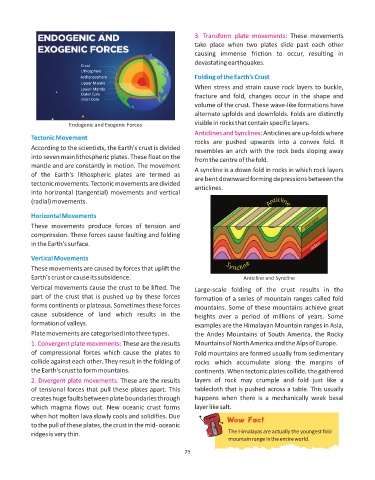
                                                                    Anticlines and Synclines: Anticlines are up-folds where
            Tectonic Movement
                                                                    rocks  are  pushed  upwards  into  a  convex  fold.  It
            According to the scientists, the Earth's crust is divided
                                                                    resembles an arch with the rock beds sloping away
            into seven main lithospheric plates. These float on the
                                                                    from the centre of the fold.
            mantle and are constantly in motion. The movement
                                                                    A syncline is a down-fold in rocks in which rock layers
            of  the  Earth's  lithospheric  plates  are  termed  as
                                                                    are bent downward forming depressions between the
            tectonic movements. Tectonic movements are divided
                                                                    anticlines.
            into horizontal (tangential) movements and vertical
            (radial) movements.

            Horizontal Movements
            These  movements  produce  forces  of  tension  and
            compression. These forces cause faulting and folding
            in the Earth's surface.

            Vertical Movements
            These movements are caused by forces that uplift the
            Earth's crust or cause its subsidence.                                   Anticline and Syncline
            Vertical movements cause the crust to be lifted. The    Large-scale  folding  of  the  crust  results  in  the
            part of the crust that is pushed up by these forces     formation of a series of mountain ranges called fold
            forms continents or plateaus. Sometimes these forces    mountains. Some of these mountains achieve great
            cause  subsidence  of  land  which  results  in  the    heights  over  a  period  of  millions  of  years.  Some
            formation of valleys.                                   examples are the Himalayan Mountain ranges in Asia,
            Plate movements are categorised into three types.       the  Andes  Mountains  of  South  America,  the  Rocky
            1. Convergent plate movements: These are the results    Mountains of North America and the Alps of Europe.
            of  compressional  forces  which  cause  the  plates  to   Fold mountains are formed usually from sedimentary
            collide against each other. They result in the folding of   rocks  which  accumulate  along  the  margins  of
            the Earth's crust to form mountains.                    continents. When tectonic plates collide, the gathered
            2. Divergent plate movements: These are the results     layers  of  rock  may  crumple  and  fold  just  like  a
            of tensional forces that pull these plates apart. This   tablecloth that is pushed across a table. This usually
            creates huge faults between plate boundaries through    happens  when  there  is  a  mechanically  weak  basal
            which  magma  flows  out.  New  oceanic  crust  forms   layer like salt.
            when hot molten lava slowly cools and solidifies. Due               Wow Fact
            to the pull of these plates, the crust in the mid- oceanic
            ridges is very thin.                                                The Himalayas are actually the youngest fold
                                                                                mountain range in the entire world.

                                                                 79

