


Page 14 - 00inner.cdr
P. 14
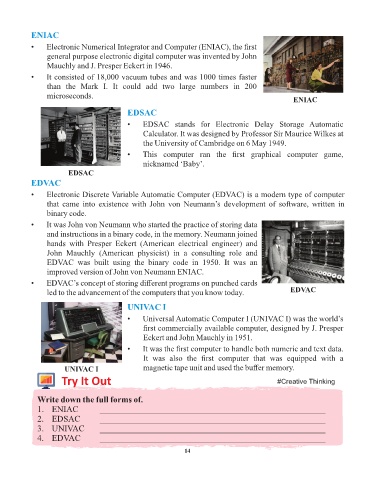
ENIAC

            •    Electronic Numerical Integrator and Computer (ENIAC), the first
                 general purpose electronic digital computer was invented by John
                 Mauchly and J. Presper Eckert in 1946.
            •    It consisted of 18,000 vacuum tubes and was 1000 times faster
                 than  the  Mark  I.  It  could  add  two  large  numbers  in  200
                 microseconds.
                                                                                                      ENIAC

                                             EDSAC
                                             •    EDSAC  stands  for  Electronic  Delay  Storage  Automatic
                                                  Calculator. It was designed by Professor Sir Maurice Wilkes at
                                                  the University of Cambridge on 6 May 1949.

                                             •    This  computer  ran  the  first  graphical  computer  game,
                                                  nicknamed ‘Baby’.
                         EDSAC
            EDVAC
            •    Electronic Discrete Variable Automatic Computer (EDVAC) is a modern type of computer
                 that  came  into  existence  with  John  von  Neumann’s  development  of  software,  written  in
                 binary code.

            •    It was John von Neumann who started the practice of storing data
                 and instructions in a binary code, in the memory. Neumann joined
                 hands  with  Presper  Eckert  (American  electrical  engineer)  and
                 John  Mauchly  (American  physicist)  in  a  consulting  role  and
                 EDVAC  was  built  using  the  binary  code  in  1950.  It  was  an
                 improved version of John von Neumann ENIAC.
            •    EDVAC’s concept of storing different programs on punched cards
                 led to the advancement of the computers that you know today.                        EDVAC


                                             UNIVAC I
                                             •    Universal Automatic Computer I (UNIVAC I) was the world’s
                                                  first commercially available computer, designed by J. Presper
                                                  Eckert and John Mauchly in 1951.
                                             •    It was the first computer to handle both numeric and text data.

                                                  It  was  also  the  first  computer  that  was  equipped  with  a
                       UNIVAC I                   magnetic tape unit and used the buffer memory.
                      Try It Out                                                                 #Creative Thinking


              Write down the full forms of.
              1.  ENIAC             ____________________________________________________
              2.  EDSAC             ____________________________________________________
              3.  UNIVAC            ____________________________________________________
              4.  EDVAC             ____________________________________________________

                                                                 14

