


Page 12 - 00inner.cdr
P. 12
the human body’s ten fingers and toes apparently caused man to construct tools to help him
            with calculations.

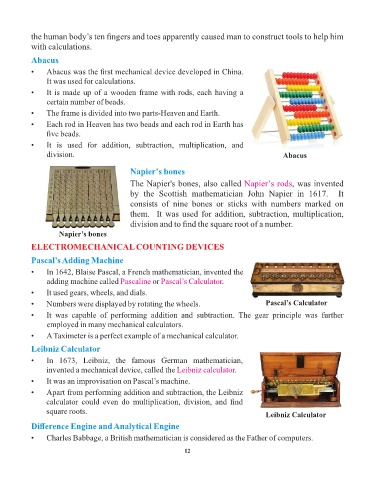
            Abacus

            •    Abacus was the first mechanical device developed in China.
                 It was used for calculations.
            •    It is made up of a wooden frame with rods, each having a
                 certain number of beads.

            •    The frame is divided into two parts-Heaven and Earth.
            •    Each rod in Heaven has two beads and each rod in Earth has
                 five beads.

            •    It  is  used  for  addition,  subtraction,  multiplication,  and
                 division.                                                                         Abacus

                                              Napier’s bones

                                              The Napier's bones, also called Napier’s rods           , was invented
                                              by  the  Scottish  mathematician  John  Napier  in  1617.    It
                                              consists  of  nine  bones  or  sticks  with  numbers  marked  on
                                              them.   It was used for addition, subtraction, multiplication,

                                              division and to find the square root of a number.
                     Napier’s bones
            ELECTROMECHANICAL COUNTING DEVICES


            Pascal’s Adding Machine
            •    In 1642, Blaise Pascal, a French mathematician, invented the
                 adding machine called Pascaline      or Pascal’s Calculator  .
            •    It used gears, wheels, and dials.

            •    Numbers were displayed by rotating the wheels.                              Pascal’s Calculator
            •    It  was  capable  of  performing  addition  and  subtraction.  The  gear  principle  was  further
                 employed in many mechanical calculators.

            •    A Taximeter is a perfect example of a mechanical calculator.
            Leibniz Calculator

            •    In  1673,  Leibniz,  the  famous  German  mathematician,
                 invented a mechanical device, called the Leibniz calculator      .

            •    It was an improvisation on Pascal’s machine.
            •    Apart from performing addition and subtraction, the Leibniz
                 calculator  could  even  do  multiplication,  division,  and  find
                 square roots.
                                                                                             Leibniz Calculator
            Difference Engine and Analytical Engine

            •    Charles Babbage, a British mathematician is considered as the Father of computers.

                                                                 12

