


Page 7 - 00inner.cdr
P. 7
Nowadays, external hard disks are also available. They are small in size and can be
                 carried anywhere.


                                                                    D
                                                         C

                                                                                        M
            2.   CD-ROM : CD-ROM             stands for ompact  isc- ead  nly  emory.
                                                                           R
                                                                                  O
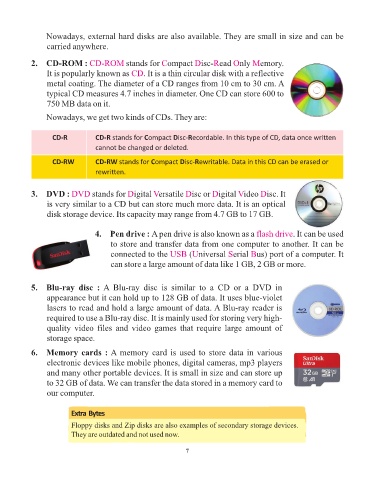
                 It is popularly known as CD       . It is a thin circular disk with a reflective
                 metal coating. The diameter of a CD ranges from 10 cm to 30 cm. A
                 typical CD measures 4.7 inches in diameter. One CD can store 600 to
                 750 MB data on it.
                 Nowadays, we get two kinds of CDs. They are:


                   CD-R           CD-R stands for Compact Disc-Recordable. In this type of CD, data once written
                                  cannot be changed or deleted.

                   CD-RW          CD-RW stands for Compact Disc-Rewritable. Data in this CD can be erased or
                                  rewritten.


                                                                                           D
                                                                 D
                                             D
                                                      V
                                                                                   V
                                                                          D
            3.   DVD : DVD       stands for  igital  ersatile  isc or  igital  ideo  isc. It
                 is very similar to a CD but can store much more data. It is an optical
                 disk storage device. Its capacity may range from 4.7 GB to 17 GB.
                                  4.   Pen drive : A pen drive is also known as a flash drive         . It can be used
                                       to store and transfer data from one computer to another. It can be
                                                                   U
                                                                                S
                                       connected to the USB       ( niversal  erial  us) port of a computer. It
                                                                                        B
                                       can store a large amount of data like 1 GB, 2 GB or more.

            5.   Blu-ray  disc  : A  Blu-ray  disc  is  similar  to  a  CD  or  a  DVD  in

                 appearance but it can hold up to 128 GB of data. It uses blue-violet
                 lasers to read and hold a large amount of data. A Blu-ray reader is
                 required to use a Blu-ray disc. It is mainly used for storing very high-
                 quality  video  files  and  video  games  that  require  large  amount  of
                 storage space.

            6.   Memory cards : A memory card is used to store data in various

                 electronic devices like mobile phones, digital cameras, mp3 players
                 and many other portable devices. It is small in size and can store up
                 to 32 GB of data. We can transfer the data stored in a memory card to
                 our computer.


                          Extra Bytes

                          Floppy disks and Zip disks are also examples of secondary storage devices.
                          They are outdated and not used now.


                                                                 7

