


Page 15 - 00inner.cdr
P. 15
GENERATIONS OF COMPUTERS

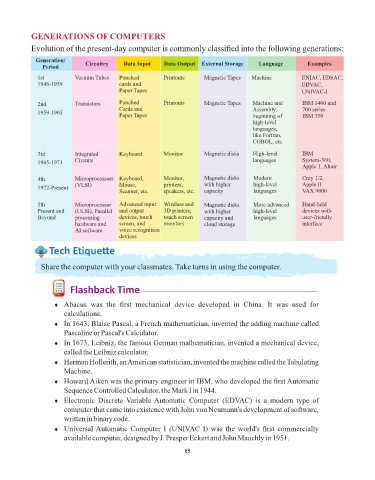
            Evolution of the present-day computer is commonly classified into the following generations:
             Generation/
                               Circuitry    Data Input    Data Output  External Storage   Language         Examples
                Period
              1st          Vacuum Tubes   Punched         Printouts     Magnetic Tapes  Machine          ENIAC, EDSAC,
              1946-1959                   cards and                                                      EDVAC,
                                          Paper Tapes                                                    UNIVAC-I

              2nd          Transistors    Punched         Printouts     Magnetic Tapes  Machine and      IBM 1400 and
                                          Cards and                                     Assembly;        700 series
              1959-1965
                                          Paper Tapes                                   beginning of     IBM 350
                                                                                        high-level
                                                                                        languages,
                                                                                        like Fortran,
                                                                                        COBOL, etc.

              3rd          Integrated     Keyboard        Monitor       Magnetic disks  High-level       IBM
              1965-1971    Circuits                                                     languages        System-360,
                                                                                                         Apple 1, Altair

              4th          Microprocessors   Keyboard,    Monitor,      Magnetic disks   Modern          Cray 1/2,
                           (VLSI)         Mouse,          printers,     with higher      high-level      Apple II
              1972-Present
                                          Scanner, etc.   speakers, etc.  capacity       languages       VAX 9000

              5th          Microprocessor   Advanced input   Wireless and   Magnetic disks  More advanced   Hand-held
              Present and   (ULSI), Parallel   and output   3D printers,   with higher   high-level      devices with
              Beyond       processing     devices, touch   touch screen   capacity and   languages       user-friendly
                           hardware and   screen, and     monitors      cloud storage                    interface
                           AI software    voice recognition
                                          devices

                  Tech Et ique e


               Share the computer with your classmates. Take turns in using the computer.


                         Flashback Time


                    ¨  Abacus  was  the  first  mechanical  device  developed  in  China.  It  was  used  for
                       calculations.
                    ¨  In 1643, Blaise Pascal, a French mathematician, invented the adding machine called
                       Pascaline or Pascal's Calculator.
                    ¨  In 1673, Leibniz, the famous German mathematician, invented a mechanical device,
                       called the Leibniz calculator.

                    ¨  Herman Hollerith, an American statistician, invented the machine called the Tabulating
                       Machine.

                    ¨  Howard Aiken was the primary engineer in IBM, who developed the first Automatic
                       Sequence Controlled Calculator, the Mark I in 1944.
                    ¨  Electronic  Discrete  Variable Automatic  Computer  (EDVAC)  is  a  modern  type  of
                       computer that came into existence with John von Neumann's development of software,
                       written in binary code.
                    ¨  Universal Automatic Computer I  (UNIVAC  I)  was  the world's  first  commercially
                       available computer, designed by J. Presper Eckert and John Mauchly in 1951.

                                                                 15

