


Page 107 - Innovator's Science-8
P. 107
Chemists use knowledge of elements and compounds to make medicines,
                 Science             vaccines, and fertilisers that improve health and increase food production.
                     Bytes

                                     Engineers and material scientists use this knowledge to develop stronger
                           Testimony
             An example of a 'wonder'   and more useful materials, such as stainless steel, which is an alloy stronger
               material developed by   than pure iron. Common building materials like wood, steel, and concrete
               material scien sts is   are examples of mixtures used in everyday life.
              graphene aerogel. This is
             made from carbon and is   You learnt that various metals are obtained from minerals.
               said to be the lightest
             material on earth. It is so   Let us learn about these minerals.
              light that even grass can
             hold it. It is highly porous   WHAT ARE MINERALS?
             and therefore, has a high
              absorbing capacity. For   Most rocks are made up of a mixture of minerals that can be seen with the
                this reason, it can   eyes or through a magnifying glass or microscope. Some minerals, called
              poten ally be used as an   native minerals, are pure elements and not compounds; examples include
              environmental cleaner,
              for example, to clean up   metals like gold, silver, and copper, and non-metals like sulfur and carbon.
              oil spills in both seas and   However, most minerals are compounds formed by combining two or more
               on land. It is useful in
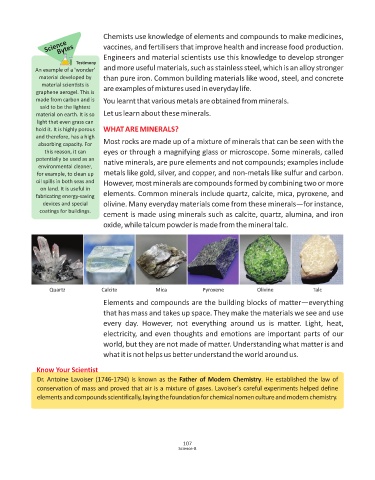
             fabrica ng energy-saving   elements. Common minerals include quartz, calcite, mica, pyroxene, and
                devices and special   olivine. Many everyday materials come from these minerals—for instance,
               coa ngs for buildings.
                                     cement is made using minerals such as calcite, quartz, alumina, and iron
                                     oxide, while talcum powder is made from the mineral talc.


                  Quartz            Calcite            Mica            Pyroxene           Olivine            Talc
                                     Elements and compounds are the building blocks of matter—everything

                                     that has mass and takes up space. They make the materials we see and use
                                     every  day.  However,  not  everything  around  us  is  matter.  Light,  heat,
                                     electricity, and even thoughts and emotions are important parts of our
                                     world, but they are not made of matter. Understanding what matter is and

                                     what it is not helps us better understand the world around us.

              Know Your Scientist
              Dr. Antoine Lavoiser (1746-1794) is known as the Father of Modern Chemistry. He established the law of
              conservation of mass and proved that air is a mixture of gases. Lavoiser's careful experiments helped define
              elements and compounds scientifically, laying the foundation for chemical nomen culture and modern chemistry.


                                                                107
                                                               Science-8

