


Page 104 - Innovator's Science-8
P. 104
exist  in  different  states—solid,  liquid,  and  gas—depending  on  its
                                     temperature. The particles of water stay the same during these changes;

                                     they just move differently. For example, in ice, the particles vibrate closely
                                     in fixed positions. In liquid water, the particles move more freely and can
                                     slide past each other. When water turns into vapor, the particles move very
                                     fast and spread apart. These changes between ice, water, and vapour are

                                     called  physical  changes  because  the  water  itself  does  not  change
                                     chemically. Now, if we pass electricity through water, we can observe how
                                     electricity affects these particles in a new way.


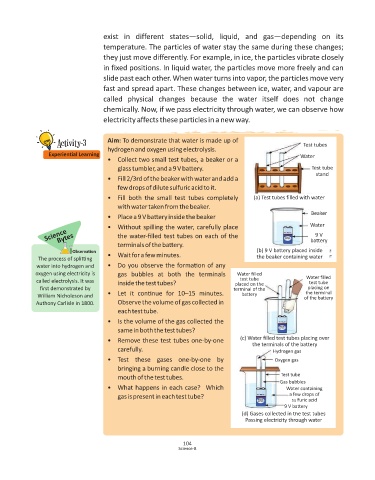
                     Activity-3       Aim: To demonstrate that water is made up of                        Test tubes
                                      hydrogen and oxygen using electrolysis.
                  Experiential Learning                                                                  Water
                                      •  Collect two small test tubes, a beaker or a
                                          glass tumbler, and a 9 V ba ery.                                   Test tube
                                                                                                              stand
                                      •  Fill 2/3rd of the beaker with water and add a
                                          few drops of dilute sulfuric acid to it.
                                      •  Fill  both  the  small  test  tubes  completely   (a) Test tubes filled with water
                                          with water taken from the beaker.
                                                                                                            Beaker
                                      •  Place a 9 V ba ery inside the beaker
                                      •  Without spilling the water, carefully place                        Water
                 Science                  the water-filled test tubes on each of the                           9 V
                     Bytes
                                          terminals of the ba ery.                                          battery
                          Observation                                                     (b) 9 V battery placed inside
                                      •  Wait for a few minutes.                          the beaker containing water
              The process of spli ng
              water into hydrogen and   •  Do you observe the forma on of any
             oxygen using electricity is   gas  bubbles  at  both  the  terminals   Water filled
                                                                                    test tube
              called electrolysis. It was   inside the test tubes?                placed on the            Water filled
                                                                                                            test tube
               first demonstrated by                                               terminal of the          placing on
                                                                                                           the terminal
              William Nicholeson and   •  Let  it  con nue  for  10–15  minutes.     battery              of the battery
             Authony Carlisle in 1800.    Observe the volume of gas collected in
                                          each test tube.
                                      •  Is the volume of the gas collected the
                                          same in both the test tubes?

                                      •  Remove these test tubes one-by-one         (c) Water filled test tubes placing over
                                                                                        the terminals of the battery
                                          carefully.                                           Hydrogen gas
                                      •  Test  these  gases  one-by-one  by                     Oxygen gas
                                          bringing a burning candle close to the
                                                                                                  Test tube
                                          mouth of the test tubes.
                                                                                                  Gas bubbles
                                      •  What happens in each case?   Which                         Water containing
                                          gas is present in each test tube?                          a few drops of
                                                                                                      sulfuric acid
                                                                                                   9 V battery
                                                                                     (d) Gases collected in the test tubes
                                                                                      Passing electricity through water


                                                                104
                                                               Science-8

