


Page 105 - Innovator's Science-8
P. 105
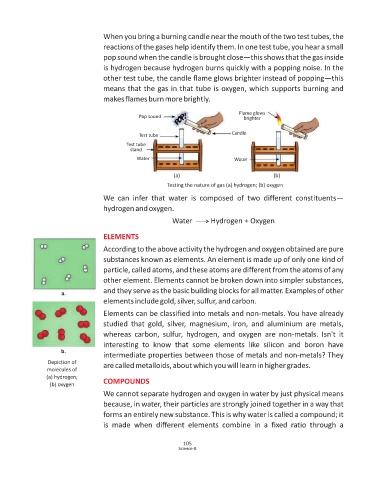
When you bring a burning candle near the mouth of the two test tubes, the
                                     reactions of the gases help identify them. In one test tube, you hear a small

                                     pop sound when the candle is brought close—this shows that the gas inside
                                     is hydrogen because hydrogen burns quickly with a popping noise. In the
                                     other test tube, the candle flame glows brighter instead of popping—this
                                     means that the gas in that tube is oxygen, which supports burning and

                                     makes flames burn more brightly.

                                                                                    Flame glows
                                                 Pop sound                           brighter


                                                 Test tube                       Candle
                                             Test tube
                                              stand
                                                Water                             Water

                                                             (a)                                (b)
                                                           Testing the nature of gas (a) hydrogen; (b) oxygen

                                     We  can  infer  that  water  is  composed  of  two  different  constituents—
                                     hydrogen and oxygen.

                                                             Water          Hydrogen + Oxygen

                                     ELEMENTS

                                     According to the above activity the hydrogen and oxygen obtained are pure
                                     substances known as elements. An element is made up of only one kind of
                                     particle, called atoms, and these atoms are different from the atoms of any

                                     other element. Elements cannot be broken down into simpler substances,
                                     and they serve as the basic building blocks for all matter. Examples of other
                      a.
                                     elements include gold, silver, sulfur, and carbon.

                                     Elements can be classified into metals and non-metals. You have already
                                     studied  that  gold,  silver,  magnesium,  iron,  and  aluminium  are  metals,
                                     whereas  carbon,  sulfur,  hydrogen,  and  oxygen  are  non-metals.  Isn't  it

                                     interesting  to  know  that  some  elements  like  silicon  and  boron  have
                      b.
                                     intermediate properties between those of metals and non-metals? They
                  Depiction of       are called metalloids, about which you will learn in higher grades.
                 molecules of
                 (a) hydrogen;
                  (b) oxygen         COMPOUNDS
                                     We cannot separate hydrogen and oxygen in water by just physical means
                                     because, in water, their particles are strongly joined together in a way that

                                     forms an entirely new substance. This is why water is called a compound; it
                                     is  made  when  different  elements  combine  in  a  fixed  ratio  through  a


                                                                105
                                                               Science-8

