


Page 101 - Innovator's Science-8
P. 101
not evenly mixed throughout the mixture. Can you identify a few more
                                     examples of non-uniform mixtures around you?

                                     On the other hand, some mixtures have components that cannot be seen
                                     separately even with the help of a microscope. For example, sugar and
                                     water particles cannot be seen separately in their mixture. Such types of

                                     mixtures, where the components are evenly distributed and cannot be
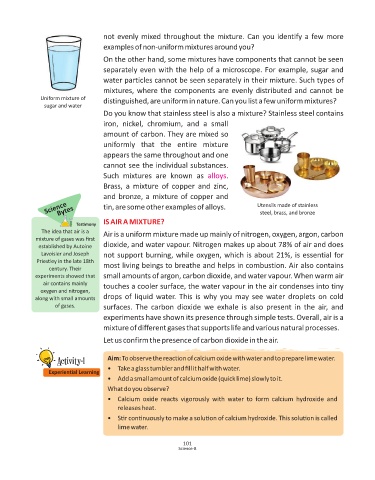
               Uniform mixture of    distinguished, are uniform in nature. Can you list a few uniform mixtures?
                sugar and water
                                     Do you know that stainless steel is also a mixture? Stainless steel contains
                                     iron,  nickel,  chromium,  and  a  small
                                     amount of carbon. They are mixed so
                                     uniformly  that  the  entire  mixture

                                     appears the same throughout and one
                                     cannot see the individual substances.
                                     Such  mixtures  are  known  as  alloys    .
                                     Brass,  a  mixture  of  copper  and  zinc,

                                     and bronze, a mixture of copper and
                 Science             tin, are some other examples of alloys.              Utensils made of stainless
                     Bytes
                                                                                           steel, brass, and bronze
                                     IS AIR A MIXTURE?
                           Testimony
               The idea that air is a   Air is a uniform mixture made up mainly of nitrogen, oxygen, argon, carbon
             mixture of gases was first
              established by Autoine   dioxide, and water vapour. Nitrogen makes up about 78% of air and does
               Lavoisier and Joseph   not support burning, while oxygen, which is about 21%, is essential for
              Priestley in the late 18th
                  century. Their     most living beings to breathe and helps in combustion. Air also contains
             experiments showed that   small amounts of argon, carbon dioxide, and water vapour. When warm air
                air contains mainly   touches a cooler surface, the water vapour in the air condenses into tiny
               oxygen and nitrogen,
             along with small amounts   drops of liquid water. This is why you may see water droplets on cold
                    of gases.        surfaces.  The  carbon  dioxide  we  exhale  is  also  present  in  the  air,  and

                                     experiments have shown its presence through simple tests. Overall, air is a
                                     mixture of different gases that supports life and various natural processes.

                                     Let us confirm the presence of carbon dioxide in the air.


                     Activity-1       Aim: To observe the reac on of calcium oxide with water and to prepare lime water.
                                      •  Take a glass tumbler and fill it half with water.
                  Experiential Learning
                                      •  Add a small amount of calcium oxide (quick lime) slowly to it.
                                      What do you observe?
                                      •  Calcium  oxide  reacts  vigorously  with  water  to  form  calcium  hydroxide  and
                                          releases heat.

                                      •  S r con nuously to make a solu on of calcium hydroxide. This solu on is called
                                          lime water.


                                                                101
                                                               Science-8

