


Page 97 - Innovator's Science-8
P. 97
4.   Why do gases mix easily, while solids do not?
              Ans.  Gas par cles are very  ny and have a lot of empty space between them. Because they are so far apart,
                   they can move quickly and freely in all direc ons. The forces that keep them together are very weak, so
                   they don’t s ck to each other. That’s why gases can spread out easily and fill any container or space they
                   are in.

              5.   When spilled on the table, milk in a glass tumbler flows and spreads out, but the glass tumbler stays in
                   the same shape. Jus fy this statement.

              Ans.  In this case, milk is spilled on the table, and it spreads around the table because its state is liquid. Liquids
                   can take the shape of their surrounding because their molecules are free to move. This is the reason the
                   milk flows around the table. Whereas the glass tumbler’s shape does not change because it is a solid. In
                   solids, the molecules are closely packed.

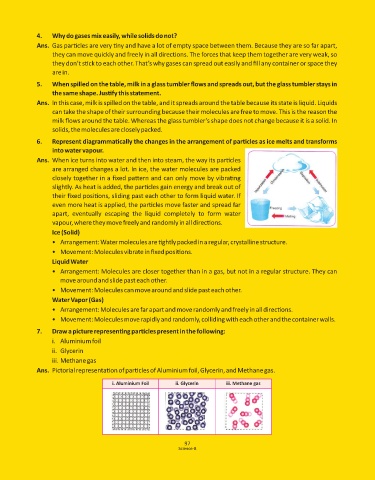
              6.   Represent diagramma cally the changes in the arrangement of par cles as ice melts and transforms
                   into water vapour.
              Ans.  When ice turns into water and then into steam, the way its par cles
                   are arranged changes a lot. In ice, the water molecules are packed
                   closely together in a fixed pa ern and can only move by vibra ng
                   slightly. As heat is added, the par cles gain energy and break out of
                   their fixed posi ons, sliding past each other to form liquid water. If
                   even more heat is applied, the par cles move faster and spread far
                   apart,  eventually  escaping  the  liquid  completely  to  form  water
                   vapour, where they move freely and randomly in all direc ons.

                   Ice (Solid)
                   •  Arrangement: Water molecules are  ghtly packed in a regular, crystalline structure.
                   •  Movement: Molecules vibrate in fixed posi ons.
                   Liquid Water
                   •  Arrangement: Molecules are closer together than in a gas, but not in a regular structure. They can
                      move around and slide past each other.
                   •  Movement: Molecules can move around and slide past each other.
                   Water Vapor (Gas)
                   •  Arrangement: Molecules are far apart and move randomly and freely in all direc ons.
                   •  Movement: Molecules move rapidly and randomly, colliding with each other and the container walls.

              7.   Draw a picture represen ng par cles present in the following:
                   i.  Aluminium foil
                   ii.  Glycerin
                   iii. Methane gas
              Ans.  Pictorial representa on of par cles of Aluminium foil, Glycerin, and Methane gas.

                                        i. Aluminium Foil     ii. Glycerin     iii. Methane gas


                                                                 97
                                                               Science-8

