


Page 94 - Innovator's Science-8
P. 94
Science             What do you observe in each case? Do the sand particles dissolve? Does the
                     Bytes
                                     volume of water in the vessel change after mixing, and why?
                           Testimony  Sand  is  a  solid  that  does  not  dissolve  in  water.
              When sugar is added to   When  added  to  water,  the  sand  particles  settle
              water, it first raises the
             water level slightly. But as   down  and  occupy  some  space  in  the  container,
                                                                                                                a. Solid
               it dissolves, the level   causing the total volume to increase. What do you
              decreases because the
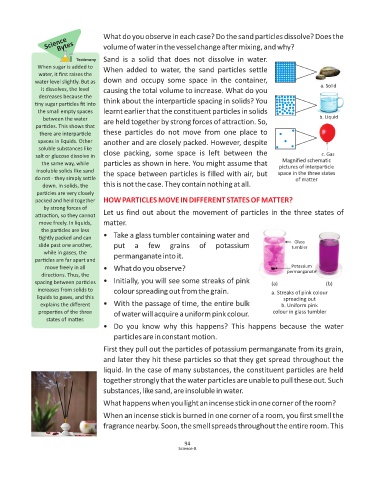
              ny sugar par cles fit into   think about the interparticle spacing in solids? You
              the small empty spaces   learnt earlier that the constituent particles in solids
                between the water    are held together by strong forces of attraction. So,                     b. Liquid
             par cles. This shows that
               there are interpar cle   these  particles  do  not  move  from  one  place  to
              spaces in liquids. Other   another and are closely packed. However, despite
              soluble substances like
             salt or glucose dissolve in   close  packing,  some  space  is  left  between  the                 c. Gas
                                                                                                   Magnified schematic
               the same way, while   particles as shown in here. You might assume that           pictures of interparticle
              insoluble solids like sand   the space between particles is filled with air, but   space in the three states
             do not - they simply se le                                                                of matter
                down. In solids, the   this is not the case. They contain nothing at all.
              par cles are very closely
             packed and held together   HOW PARTICLES MOVE IN DIFFERENT STATES OF MATTER?
                by strong forces of
             a rac on, so they cannot   Let us find out about the movement of particles in the three states of
              move freely. In liquids,   matter.
               the par cles are less
                ghtly packed and can   •  Take a glass tumbler containing water and
                                                                                                       Glass
              slide past one another,   put  a  few  grains  of  potassium                            tumbler
                while in gases, the     permanganate into it.
             par cles are far apart and
                 move freely in all   •  What do you observe?                                         Potassium
               direc ons. Thus, the                                                                 permanganate
             spacing between par cles   •  Initially, you will see some streaks of pink        (a)                (b)
              increases from solids to   colour spreading out from the grain.                  a. Streaks of pink colour
              liquids to gases, and this                                                           spreading out
               explains the different   •  With the passage of time, the entire bulk               b. Uniform pink
              proper es of the three    of water will acquire a uniform pink colour.           colour in glass tumbler
                 states of ma er.
                                     •  Do  you  know  why  this  happens?  This  happens  because  the  water
                                        particles are in constant motion.
                                     First they pull out the particles of potassium permanganate from its grain,

                                     and later they hit these particles so that they get spread throughout the
                                     liquid. In the case of many substances, the constituent particles are held
                                     together strongly that the water particles are unable to pull these out. Such

                                     substances, like sand, are insoluble in water.
                                     What happens when you light an incense stick in one corner of the room?

                                     When an incense stick is burned in one corner of a room, you first smell the
                                     fragrance nearby. Soon, the smell spreads throughout the entire room. This


                                                                 94
                                                               Science-8

