


Page 91 - Innovator's Science-8
P. 91
can make the water level appear to decrease slightly when poured into
                                     another container, but the true volume of the water remains the same.

                                     Overall, liquids fit the shape of their container but keep a steady volume
                                     because their particles can move within a limited space.
                                     Let us now compare interparticle forces of attraction in liquids and solids.
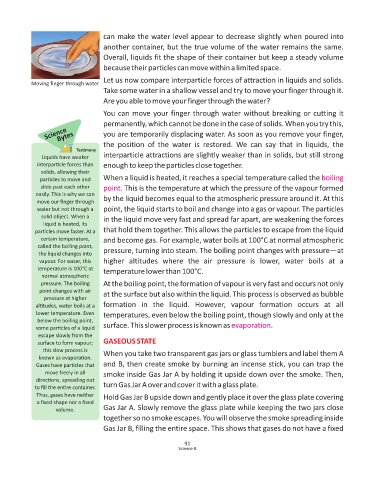
            Moving finger through water
                                     Take some water in a shallow vessel and try to move your finger through it.
                                     Are you able to move your finger through the water?

                                     You can move your finger through water without breaking or cutting it
                                     permanently, which cannot be done in the case of solids. When you try this,
                 Science             you are temporarily displacing water. As soon as you remove your finger,
                     Bytes
                                     the  position  of  the  water  is  restored.  We  can  say  that  in  liquids,  the
                           Testimony
               Liquids have weaker   interparticle attractions are slightly weaker than in solids, but still strong
              interpar cle forces than   enough to keep the particles close together.
               solids, allowing their
               par cles to move and   When a liquid is heated, it reaches a special temperature called the boiling
               slide past each other   point. This is the temperature at which the pressure of the vapour formed
             easily. This is why we can
              move our finger through   by the liquid becomes equal to the atmospheric pressure around it. At this
              water but not through a   point, the liquid starts to boil and change into a gas or vapour. The particles
               solid object. When a   in the liquid move very fast and spread far apart, are weakening the forces
                liquid is heated, its
             par cles move faster. At a   that hold them together. This allows the particles to escape from the liquid
               certain temperature,   and become gas. For example, water boils at 100°C at normal atmospheric
              called the boiling point,
              the liquid changes into   pressure, turning into steam. The boiling point changes with pressure—at
               vapour. For water, this   higher  altitudes  where  the  air  pressure  is  lower,  water  boils  at  a
              temperature is 100°C at   temperature lower than 100°C.
               normal atmospheric
               pressure. The boiling   At the boiling point, the formation of vapour is very fast and occurs not only
               point changes with air   at the surface but also within the liquid. This process is observed as bubble
                pressure at higher
             al tudes, water boils at a   formation  in  the  liquid.  However,  vapour  formation  occurs  at  all
              lower temperature. Even   temperatures, even below the boiling point, though slowly and only at the
              below the boiling point,
             some par cles of a liquid   surface. This slower process is known as evaporation  .
              escape slowly from the
              surface to form vapour;   GASEOUS STATE
                this slow process is   When you take two transparent gas jars or glass tumblers and label them A
              known as evapora on.
             Gases have par cles that   and B, then create smoke by burning an incense stick, you can trap the
                 move freely in all   smoke inside Gas Jar A by holding it upside down over the smoke. Then,
              direc ons, spreading out
             to fill the en re container.   turn Gas Jar A over and cover it with a glass plate.
              Thus, gases have neither   Hold Gas Jar B upside down and gently place it over the glass plate covering
              a fixed shape nor a fixed
                    volume.          Gas Jar A. Slowly remove the glass plate while keeping the two jars close
                                     together so no smoke escapes. You will observe the smoke spreading inside

                                     Gas Jar B, filling the entire space. This shows that gases do not have a fixed

                                                                 91
                                                               Science-8

