


Page 87 - Innovator's Science-8
P. 87
7             Particulate Nature


                              of Matter


                                       Intended Learning Outcomes
                                          What Decides Different States of Ma er?      Solid State
                                          Gaseous State                               How Does the Interpar cle
                                          How Par cles Move in Different States        Spacing Differ in the Three
                                          of Ma er?                                   States of Ma er?


                                       Stepping Stones

                                       1.  Why can water hold the form of hands when contained, but not keep it a er
                                           being released?
                                       2.  Why does a balloon gain weight when filled with air, even though air is not
                                           visible?


                                     Matter is anything that has mass and occupies space. The observable world
                                     is  composed  of  solids,  liquids,  and  gases—particles  so  small  that  they
                        a.
                                     cannot be seen even under an ordinary microscope. These particles are
                                     always in motion and are held together by forces of attraction, with the

                                     extent of movement and space between them determining if the matter
                        b.           appears as a solid, liquid, or gas.
                                     Pebbles, stones, and sand found on riverbanks or beaches originally come

                                     from larger rocks in the mountains. Over time, the rocks in the mountains
                                     break down because of weathering and erosion. Weathering causes the
                        c.
                                     rocks to become weaker and break apart into smaller pieces, while erosion

                                     means that rivers pick up these pieces and carry them along. As the river
                                     flows, it grinds these fragments against each other breaking them further
                                     into pebbles, sand, and fine clay. The river then carries these small pieces
                        d.           from the mountains all the way to the plains, where they are left behind on
                                     riverbanks and beaches. Over time, all the pebbles and sand seen along
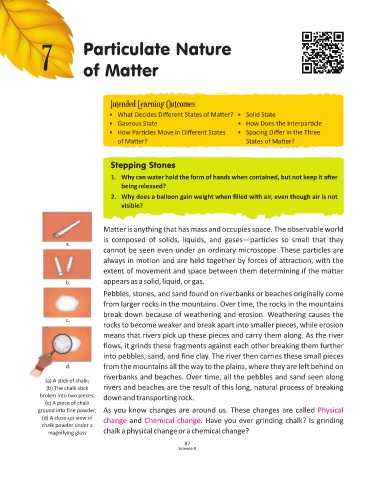
                 (a) A stick of chalk;
                 (b) The chalk stick   rivers and beaches are the result of this long, natural process of breaking
               broken into two pieces;  down and transporting rock.
                 (c) A piece of chalk
              ground into fine powder;  As you know changes are around us. These changes are called Physical
                (d) A close-up view of   change and  Chemical change. Have you ever grinding chalk? Is grinding
               chalk powder under a
                  magnifying glass   chalk a physical change or a chemical change?
                                                                 87
                                                               Science-8

