


Page 89 - Innovator's Science-8
P. 89
and  hold  the  particles  tightly  together,  while  in  liquids,  the  forces  are
                 Science             weaker and let particles slide past one another. In gases, the forces are very
                     Bytes

                                     weak, so particles move freely and stay far apart.
                           Testimony
                Acharya Kanad, an
                  ancient Indian     SOLID STATE
             philosopher, was the first   How are constituent particles held together in solids?
             to talk about the idea of a
              Parmanu, which means
              atom. He believed that
             everything in the world is
                 made up of  ny,
             indivisible par cles called   Iron nail  Rock salt      Stone       Wooden block     Key      Piece of aluminium
              Parmanu that cannot be                                   Some solid objects
              broken down further. He
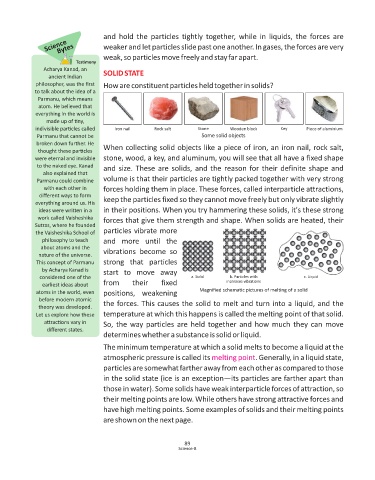
              thought these par cles   When collecting solid objects like a piece of iron, an iron nail, rock salt,
             were eternal and invisible   stone, wood, a key, and aluminum, you will see that all have a fixed shape
              to the naked eye. Kanad   and size. These are solids, and the reason for their definite shape and
                also explained that
              Parmanu could combine   volume is that their particles are tightly packed together with very strong
                with each other in   forces holding them in place. These forces, called interparticle attractions,
               different ways to form   keep the particles fixed so they cannot move freely but only vibrate slightly
             everything around us. His
              ideas were wri en in a   in their positions. When you try hammering these solids, it's these strong
              work called Vaisheshika   forces that give them strength and shape. When solids are heated, their
             Sutras, where he founded
             the Vaisheshika School of   particles vibrate more
                philosophy to teach   and  more  until  the
               about atoms and the
              nature of the universe.   vibrations  become  so
              This concept of Parmanu   strong  that  particles
                by Acharya Kanad is   start  to  move  away
               considered one of the                               a. Solid     b. Particles with         c. Liquid
                earliest ideas about   from    their     fixed                 increases vibrations
              atoms in the world, even   positions,  weakening        Magnified schematic pictures of melting of a solid
              before modern atomic
              theory was developed.   the forces. This causes the solid to melt and turn into a liquid, and the
             Let us explore how these   temperature at which this happens is called the melting point of that solid.
                a rac ons vary in    So, the way particles are held together and how much they can move
                 different states.
                                     determines whether a substance is solid or liquid.

                                     The minimum temperature at which a solid melts to become a liquid at the
                                     atmospheric pressure is called its melting point    . Generally, in a liquid state,
                                     particles are somewhat farther away from each other as compared to those

                                     in the solid state (ice is an exception—its particles are farther apart than
                                     those in water). Some solids have weak interparticle forces of attraction, so
                                     their melting points are low. While others have strong attractive forces and

                                     have high melting points. Some examples of solids and their melting points
                                     are shown on the next page.


                                                                 89
                                                               Science-8

