


Page 93 - Innovator's Science-8
P. 93
What do you observe?

                                     As you do this, you will notice that the volume of air inside the syringe
                                     decreases. What can we say about the behaviour of gas in the syringe?
                                     When you compress the air by pushing the plunger, the particles are forced
                                     to  come  closer.  This  shows  that  the  gas  particles  have  a  lot  of  space

                                     between them in their natural state, and this space can be reduced by
                                     applying  external  pressure.  If  you  stop  pushing  the  plunger,  the  gas
                                     particles  spread,  and  the  plunger  moves  back  to  its  original  position.

                                     Repeat this activity using water and observe. You would observe that water
                                     is practically incompressible. Let us perform another activity to learn about
                                     the interparticle spaces in liquids.


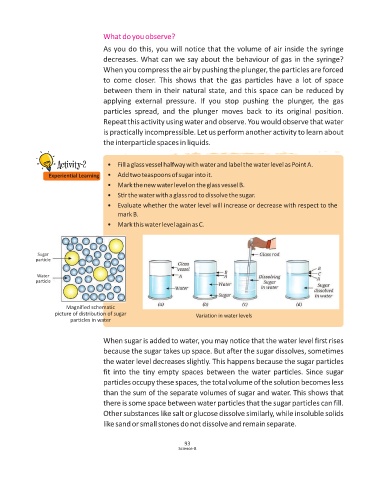
                     Activity-2       •  Fill a glass vessel halfway with water and label the water level as Point A.
                  Experiential Learning  •  Add two teaspoons of sugar into it.
                                      •  Mark the new water level on the glass vessel B.
                                      •  S r the water with a glass rod to dissolve the sugar.

                                      •  Evaluate whether the water level will increase or decrease with respect to the
                                          mark B.
                                      •  Mark this water level again as C.


              Sugar
             particle

              Water
             particle


                        Magnified schematic
                    picture of distribution of sugar                 Variation in water levels
                         particles in water


                                     When sugar is added to water, you may notice that the water level first rises
                                     because the sugar takes up space. But after the sugar dissolves, sometimes
                                     the water level decreases slightly. This happens because the sugar particles
                                     fit into the tiny empty spaces between the water particles. Since sugar

                                     particles occupy these spaces, the total volume of the solution becomes less
                                     than the sum of the separate volumes of sugar and water. This shows that
                                     there is some space between water particles that the sugar particles can fill.
                                     Other substances like salt or glucose dissolve similarly, while insoluble solids

                                     like sand or small stones do not dissolve and remain separate.


                                                                 93
                                                               Science-8

