


Page 103 - Innovator's Science-8
P. 103
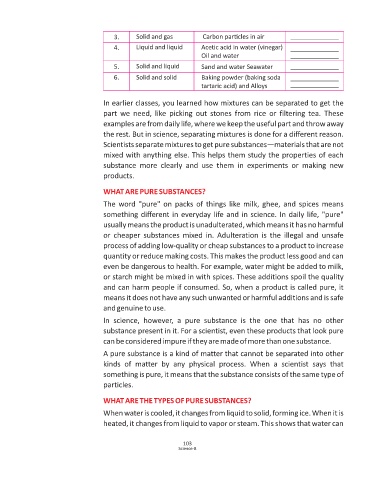
3.      Solid and gas          Carbon par cles in air        ______________

                                        4.      Liquid and liquid      Ace c acid in water (vinegar)  ______________
                                                                       Oil and water                 ______________

                                        5.      Solid and liquid       Sand and water Seawater       ______________
                                        6.      Solid and solid        Baking powder (baking soda    ______________
                                                                       tartaric acid) and Alloys     ______________

                                     In earlier classes, you learned how mixtures can be separated to get the

                                     part  we  need,  like  picking  out  stones  from  rice  or  filtering  tea.  These
                                     examples are from daily life, where we keep the useful part and throw away
                                     the rest. But in science, separating mixtures is done for a different reason.
                                     Scientists separate mixtures to get pure substances—materials that are not

                                     mixed with anything else. This helps them study the properties of each
                                     substance  more  clearly  and  use  them  in  experiments  or  making  new
                                     products.

                                     WHAT ARE PURE SUBSTANCES?

                                     The word "pure" on packs of things like milk, ghee, and spices means

                                     something different in everyday life and in science. In daily life, "pure"
                                     usually means the product is unadulterated, which means it has no harmful
                                     or  cheaper  substances  mixed  in.  Adulteration  is  the  illegal  and  unsafe
                                     process of adding low-quality or cheap substances to a product to increase
                                     quantity or reduce making costs. This makes the product less good and can

                                     even be dangerous to health. For example, water might be added to milk,
                                     or starch might be mixed in with spices. These additions spoil the quality
                                     and can harm people if consumed. So, when a product is called pure, it
                                     means it does not have any such unwanted or harmful additions and is safe

                                     and genuine to use.
                                     In  science,  however,  a  pure  substance  is  the  one  that  has  no  other
                                     substance present in it. For a scientist, even these products that look pure

                                     can be considered impure if they are made of more than one substance.

                                     A pure substance is a kind of matter that cannot be separated into other
                                     kinds  of  matter  by  any  physical  process.  When  a  scientist  says  that
                                     something is pure, it means that the substance consists of the same type of
                                     particles.


                                     WHAT ARE THE TYPES OF PURE SUBSTANCES?
                                     When water is cooled, it changes from liquid to solid, forming ice. When it is
                                     heated, it changes from liquid to vapor or steam. This shows that water can


                                                                103
                                                               Science-8

