


Page 16 - Innovator's Science-8
P. 16
slide under a microscope and draw the cells that you see in your notebook.

                                     What  did  you  observe?  You  will  observe  a  polygonshaped  structure  as
                                     shown in the given figure.  These are cheek cells, which form the inner lining
                                     of your mouth. What similarities and differences did you observe between
                 Science             the cells of onion peel in the given figure before and human cheek cells?
                     Bytes

                           Testimony  You have now seen both plant and animal cells. Let us learn more about
                                     their structure and parts.
             In 1838, German batonist
                Ma hias Schleiden    Cells have three main parts: a thin outer covering called the cell membrane       ,
              studied plant  ssues and   a jelly-like substance called cytoplasm , and a round structure inside called
              suggested that all plants
              are made of cells. A year   the nucleus . The cell membrane protects the cell and controls what goes in
             later, Theodor Schneann,   and  out,  helping  the  cell  stay  safe  and  get  the  things  it  needs.  The
               a zoologist, concluded
               that animals are also   cytoplasm fills up the space between the membrane and nucleus; it holds
                 made up of cells.   all the cell's parts and is where most of the work in the cell happens, like
                  Together, their    breaking down food and making energy. The nucleus is like the cell's control
              observa ons formed the
              basis of the cell theory,   center; it has the cell's DNA and directs all the cell's activities, like growth
             which states that cells are   and making new cells. Sometimes, in certain cells like onion skin cells, there
               the basic units of life.
               Later, Rndolf Virchow   exists an extra thick outer layer called the cell wall that gives strength and
             added that new cells arise   support. All these parts work together to keep the cell alive and healthy,
               only from pre-exis ng   which is very important for the life of every plant, animal, and person.
                      cells.
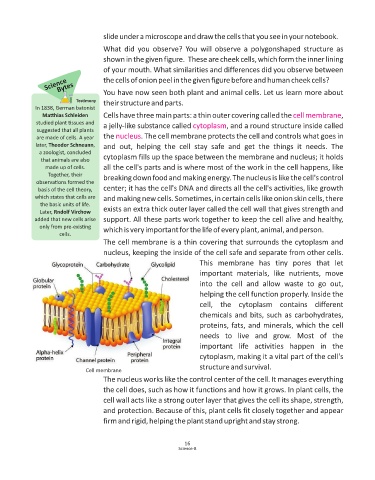
                                     The cell membrane is a thin covering that surrounds the cytoplasm and

                                     nucleus, keeping the inside of the cell safe and separate from other cells.
                                                                      This  membrane  has  tiny  pores  that  let
                                                                      important  materials,  like  nutrients,  move
                                                                      into  the  cell  and  allow  waste  to  go  out,

                                                                      helping the cell function properly. Inside the
                                                                      cell,  the  cytoplasm  contains  different
                                                                      chemicals and bits, such as carbohydrates,
                                                                      proteins, fats, and minerals, which the cell

                                                                      needs  to  live  and  grow.  Most  of  the
                                                                      important  life  activities  happen  in  the
                                                                      cytoplasm, making it a vital part of the cell's
                                                                      structure and survival.
                               Cell membrane
                                     The nucleus works like the control center of the cell. It manages everything
                                     the cell does, such as how it functions and how it grows. In plant cells, the

                                     cell wall acts like a strong outer layer that gives the cell its shape, strength,
                                     and protection. Because of this, plant cells fit closely together and appear
                                     firm and rigid, helping the plant stand upright and stay strong.


                                                                 16
                                                               Science-8

