


Page 17 - Innovator's Science-8
P. 17
Cells in all parts of a plant have tiny rod-shaped structures called plastids.
                                     Some plastids, like chloroplasts, contain chlorophyll, which makes them

                                     green and helps in photosynthesis. In non-green parts, they help in the
                                     storage of substances. Plant cells also have a large, empty-looking space
                                     called a vacuole. This helps the plant cell store important substances, get
                                     rid of waste, and maintain the shape of the cell. This gives strength and

                                     support to the plant. In animal cells, vacuoles are usually not present, if
                                     present,  they  are  usually  small.
                                     These  small  vacuoles  store
                                     certain  substances  dissolved  in.

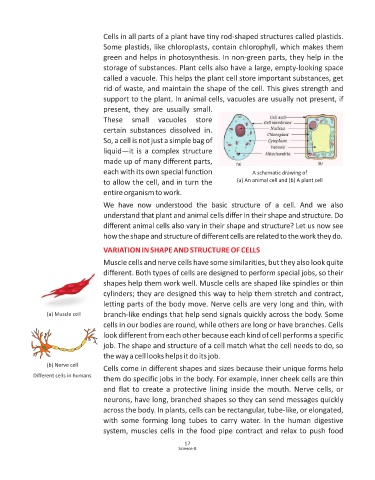
                                     So, a cell is not just a simple bag of
                                     liquid—it is a complex structure
                                     made up of many different parts,
                                     each with its own special function                 A schematic drawing of
                                     to allow the cell, and in turn the            (a) An animal cell and (b) A plant cell

                                     entire organism to work.
                                     We  have  now  understood  the  basic  structure  of  a  cell.  And  we  also

                                     understand that plant and animal cells differ in their shape and structure. Do
                                     different animal cells also vary in their shape and structure? Let us now see
                                     how the shape and structure of different cells are related to the work they do.

                                     VARIATION IN SHAPE AND STRUCTURE OF CELLS

                                     Muscle cells and nerve cells have some similarities, but they also look quite
                                     different. Both types of cells are designed to perform special jobs, so their
                                     shapes help them work well. Muscle cells are shaped like spindles or thin
                                     cylinders; they are designed this way to help them stretch and contract,

                                     letting parts of the body move. Nerve cells are very long and thin, with
                 (a) Muscle cell     branch-like endings that help send signals quickly across the body. Some
                                     cells in our bodies are round, while others are long or have branches. Cells

                                     look different from each other because each kind of cell performs a specific
                                     job. The shape and structure of a cell match what the cell needs to do, so
                                     the way a cell looks helps it do its job.
                 (b) Nerve cell
                                     Cells come in different shapes and sizes because their unique forms help
             Different cells in humans
                                     them do specific jobs in the body. For example, inner cheek cells are thin
                                     and flat to create a protective lining inside the mouth. Nerve cells, or
                                     neurons, have long, branched shapes so they can send messages quickly

                                     across the body. In plants, cells can be rectangular, tube-like, or elongated,
                                     with  some  forming  long  tubes  to  carry  water.  In  the  human  digestive
                                     system, muscles cells in the food pipe contract and relax to push food

                                                                 17
                                                               Science-8

