


Page 14 - Innovator's Science-8
P. 14
way, when we use a magnifying glass, it makes small things look bigger and
                                     clearer, allowing us to observe details that our eyes alone cannot.


                     Activity-1       Aim: To observe how a curved glass flask fulled with water magnifies objects.
                                      Materials Required: Notebook, round bo om flask, water
                  Experiential Learning
                                      Procedure and Observa on: If you take a glass flask with a round bo om and fill it
                                      with water, then close it with a cork, something interes ng happens. When you
                                      place this flask over a book and look at the le ers through it, the le ers appear
                                      bigger than they really are. This is because the flask with water bends light and
                                      works like a magnifying glass. A real magnifying glass does the same thing—it makes
                                      small objects, like an ant, look larger and
                                      clearer so you can see details of its body.
                                      For many years, people wondered about
                                      the  ny living things around them, but
                                      they could not see them with just their
                                      eyes.  The  discovery  of  the  microscope
                                      finally  allowed  humans  to  see  this
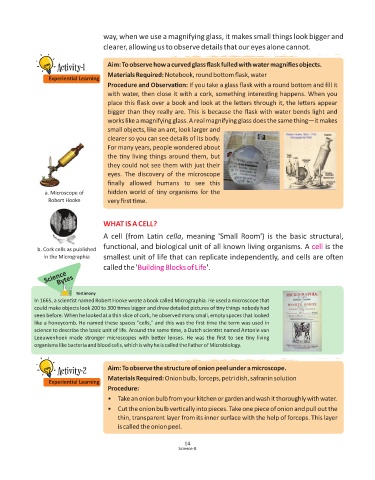
                 a. Microscope of     hidden world of  ny organisms for the
                  Robert Hooke        very first  me.


                                     WHAT IS A CELL?
                                     A  cell  (from  Latin  cella,  meaning  'Small  Room')  is  the  basic  structural,
                                     functional, and biological unit of all known living organisms. A cell        is the
              b. Cork cells as published
                in the Micrographia  smallest unit of life that can replicate independently, and cells are often
                                     called the 'Building Blocks of Life '.
                 Science
                     Bytes


                           Testimony
             In 1665, a scien st named Robert Hooke wrote a book called Micrographia. He used a microscope that
             could make objects look 200 to 300  mes bigger and drew detailed pictures of  ny things nobody had
             seen before. When he looked at a thin slice of cork, he observed many small, empty spaces that looked
             like a honeycomb. He named these spaces "cells," and this was the first  me the term was used in
             science to describe the basic unit of life. Around the same  me, a Dutch scien st named Antonie van
             Leeuwenhoek  made  stronger  microscopes  with  be er  lenses.  He  was  the  first  to  see   ny  living
             organisms like bacteria and blood cells, which is why he is called the Father of Microbiology.


                     Activity-2       Aim: To observe the structure of onion peel under a microscope.
                                      Materials Required: Onion bulb, forceps, petri dish, safranin solu on
                  Experiential Learning
                                      Procedure:
                                      •  Take an onion bulb from your kitchen or garden and wash it thoroughly with water.

                                      •  Cut the onion bulb ver cally into pieces. Take one piece of onion and pull out the
                                          thin, transparent layer from its inner surface with the help of forceps. This layer
                                          is called the onion peel.


                                                                 14
                                                               Science-8

