


Page 9 - Innovator's Science-8
P. 9
plan some simple experiments. In any experiment, there are two important
                                     things to consider—what we can change (the factors we control) and what

                                     we can observe.
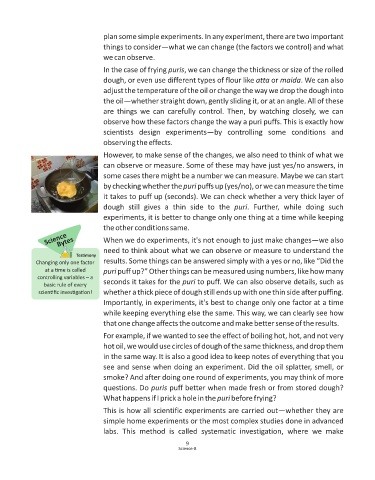
                                     In the case of frying puris, we can change the thickness or size of the rolled
                                     dough, or even use different types of flour like atta or maida. We can also

                                     adjust the temperature of the oil or change the way we drop the dough into
                                     the oil—whether straight down, gently sliding it, or at an angle. All of these
                                     are  things  we  can  carefully  control.  Then,  by  watching  closely,  we  can

                                     observe how these factors change the way a puri puffs. This is exactly how
                                     scientists  design  experiments—by  controlling  some  conditions  and
                                     observing the effects.

                                     However, to make sense of the changes, we also need to think of what we
                                     can observe or measure. Some of these may have just yes/no answers, in
                                     some cases there might be a number we can measure. Maybe we can start
                                     by checking whether the puri puffs up (yes/no), or we can measure the time

                                     it takes to puff up (seconds). We can check whether a very thick layer of
                                     dough  still  gives  a  thin  side  to  the  puri.  Further,  while  doing  such
                                     experiments, it is better to change only one thing at a time while keeping
                                     the other conditions same.
                 Science             When we do experiments, it's not enough to just make changes—we also
                     Bytes
                                     need to think about what we can observe or measure to understand the
                           Testimony
             Changing only one factor   results. Some things can be answered simply with a yes or no, like “Did the
                 at a  me is called   puri puff up?” Other things can be measured using numbers, like how many
              controlling variables – a
                basic rule of every   seconds it takes for the puri to puff. We can also observe details, such as
              scien fic inves ga on!  whether a thick piece of dough still ends up with one thin side after puffing.
                                     Importantly, in experiments, it's best to change only one factor at a time

                                     while keeping everything else the same. This way, we can clearly see how
                                     that one change affects the outcome and make better sense of the results.

                                     For example, if we wanted to see the effect of boiling hot, hot, and not very
                                     hot oil, we would use circles of dough of the same thickness, and drop them
                                     in the same way. It is also a good idea to keep notes of everything that you
                                     see and sense when doing an experiment. Did the oil splatter, smell, or

                                     smoke? And after doing one round of experiments, you may think of more
                                     questions. Do puris puff better when made fresh or from stored dough?
                                     What happens if I prick a hole in the puri before frying?

                                     This is how all scientific experiments are carried out—whether they are
                                     simple home experiments or the most complex studies done in advanced
                                     labs.  This  method  is  called  systematic  investigation,  where  we  make

                                                                 9
                                                               Science-8

