


Page 7 - Innovator's Science-8
P. 7
combine also helps us understand solutions—for example, when sugar
                                     dissolves in tea and makes it sweet.

                                     After  learning  about  particles  and                   Chaitra
                                     mixtures,  we  step  into  the                      (March 22 - April 20, 2025)
                                     fascinating  world  of  light,  we  will     SUN  MON  TUE  WED  THU  FRI    SAT
                                                                                   jefJe   meesce  cebieue  yegOe   ieg¤   Meg›eâ  Meefve
                                     explore how light reflects from flat
                                                                                                                  MAR  1  22
                                     and  curved  mirrors,  and  how  it
                                                                                   2    3     4    5    6    7    8
                                     bends when passing through lenses.              23   24   25   26   27    28   29
                                                                                   9    10   APR  11  12  16  14  15
                                     These  simple  ideas  help  us                  30   31    1    2    3    4    5
                                                                                   16  6   17  8   18  7   19  9   20 10   21 11   22 12
                                     understand  how  many  things
                                                                                   23 13   24 15   25 14   26 16   27 17   28 18   29 19
                                     around  us  work.  For  example,  the
                                                                                   30 20
                 Science             bending of light explains why we see
                     Bytes
                                     our reflection in the curved surface of a shiny spoon, or how corrective

                          Observation  glasses bend light in the right way to help people see clearly.
             The Moon takes about 27
               days to complete one   Light is not only reflected by smooth polished mirrors but also by rough
              orbit around the Earth –   surfaces, and even by the Moon. The Moon itself does not produce light; it
               but because the Earth   shines because it reflects the Sun's light. As the Earth, Moon, and Sun
              also moves around the
             Sun, we see the full cycle   change their positions relative to each other, different parts of the Moon
              of Moon phases in 29½   are lit up. This is why we see the Moon in different shapes, or phases, each
                      days.
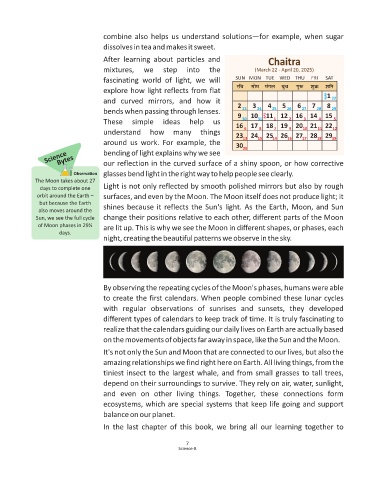
                                     night, creating the beautiful patterns we observe in the sky.


                                     By observing the repeating cycles of the Moon's phases, humans were able

                                     to create the first calendars. When people combined these lunar cycles
                                     with  regular  observations  of  sunrises  and  sunsets,  they  developed
                                     different types of calendars to keep track of time. It is truly fascinating to
                                     realize that the calendars guiding our daily lives on Earth are actually based
                                     on the movements of objects far away in space, like the Sun and the Moon.

                                     It's not only the Sun and Moon that are connected to our lives, but also the
                                     amazing relationships we find right here on Earth. All living things, from the

                                     tiniest insect to the largest whale, and from small grasses to tall trees,
                                     depend on their surroundings to survive. They rely on air, water, sunlight,
                                     and  even  on  other  living  things.  Together,  these  connections  form
                                     ecosystems, which are special systems that keep life going and support

                                     balance on our planet.
                                     In  the  last  chapter  of  this  book,  we  bring  all  our  learning  together  to


                                                                 7
                                                               Science-8

