


Page 8 - Innovator's Science-8
P. 8
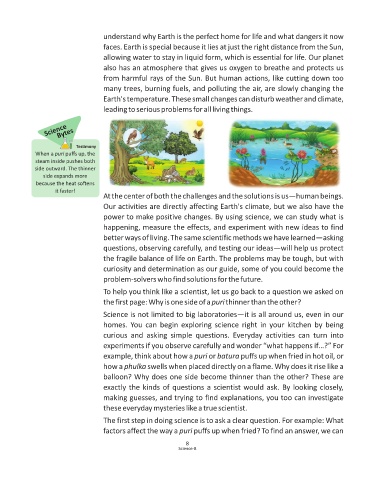
understand why Earth is the perfect home for life and what dangers it now
                                     faces. Earth is special because it lies at just the right distance from the Sun,

                                     allowing water to stay in liquid form, which is essential for life. Our planet
                                     also has an atmosphere that gives us oxygen to breathe and protects us
                                     from harmful rays of the Sun. But human actions, like cutting down too
                                     many trees, burning fuels, and polluting the air, are slowly changing the

                                     Earth's temperature. These small changes can disturb weather and climate,
                                     leading to serious problems for all living things.

                 Science
                     Bytes


                           Testimony
             When a puri puffs up, the
             steam inside pushes both
             side outward. The thinner
                side expands more
             because the heat so ens
                    it faster!
                                     At the center of both the challenges and the solutions is us—human beings.
                                     Our activities are directly affecting Earth's climate, but we also have the
                                     power to make positive changes. By using science, we can study what is
                                     happening, measure the effects, and experiment with new ideas to find
                                     better ways of living. The same scientific methods we have learned—asking

                                     questions, observing carefully, and testing our ideas—will help us protect
                                     the fragile balance of life on Earth. The problems may be tough, but with
                                     curiosity and determination as our guide, some of you could become the

                                     problem-solvers who find solutions for the future.
                                     To help you think like a scientist, let us go back to a question we asked on
                                     the first page: Why is one side of a puri thinner than the other?

                                     Science is not limited to big laboratories—it is all around us, even in our
                                     homes. You can begin exploring science right in your kitchen by being

                                     curious  and  asking  simple  questions.  Everyday  activities  can  turn  into
                                     experiments if you observe carefully and wonder “what happens if…?” For
                                     example, think about how a puri or batura puffs up when fried in hot oil, or
                                     how a phulka swells when placed directly on a flame. Why does it rise like a
                                     balloon? Why does one side become thinner than the other? These are

                                     exactly the kinds of questions a scientist would ask. By looking closely,
                                     making guesses, and trying to find explanations, you too can investigate
                                     these everyday mysteries like a true scientist.

                                     The first step in doing science is to ask a clear question. For example: What
                                     factors affect the way a puri puffs up when fried? To find an answer, we can

                                                                 8
                                                               Science-8

